What Kind of Oil Does My Car Need? Check Your Manual

Your VIN isn’t the final word on engine oil. If you’re wondering what kind of oil your car needs, start with the owner’s manual, which lists the recommended motor-oil grade and amount. The U.S. Department of Energy and EPA’s FuelEconomy.gov notes that using the manufacturer’s recommended grade of motor oil can improve gas mileage by 1%–2%. A VIN search may help narrow down the right information for your vehicle, but use the manufacturer’s recommendation to confirm the oil type before you buy or change it.
Oil labels can be confusing when they list different grades and viscosity ratings. This guide explains where to find your car’s recommendation in the manual, what to check on the oil container, and how a VIN search can help. You’ll also see why expected outdoor temperatures matter when the manufacturer specifies oil viscosity, so you can choose oil that matches your vehicle’s requirements.
Key Takeaways
- Start with your owner’s manual to find the oil grade and amount recommended for your vehicle.
- A VIN search can help identify vehicle-specific information, but use the manufacturer’s recommendation to confirm the oil choice.
- Check the oil type and required specifications together; the correct choice depends on your vehicle’s guidance.
- Use an oil change as a chance to consider other routine checks, such as tires, brakes, fluids, filters, and wipers.
Table of Contents
- Finding oil-change guidance in the vehicle manufacturer's recommendations
- Can I search what kind of oil does my car take by VIN?
- Does my car require conventional, synthetic blend, or full synthetic oil?
- What oil specifications and certifications does my car require, such as API or ILSAC?
- What other maintenance should I consider during an oil change?
- San Juan Auto Smog
Finding oil-change guidance in the vehicle manufacturer's recommendations
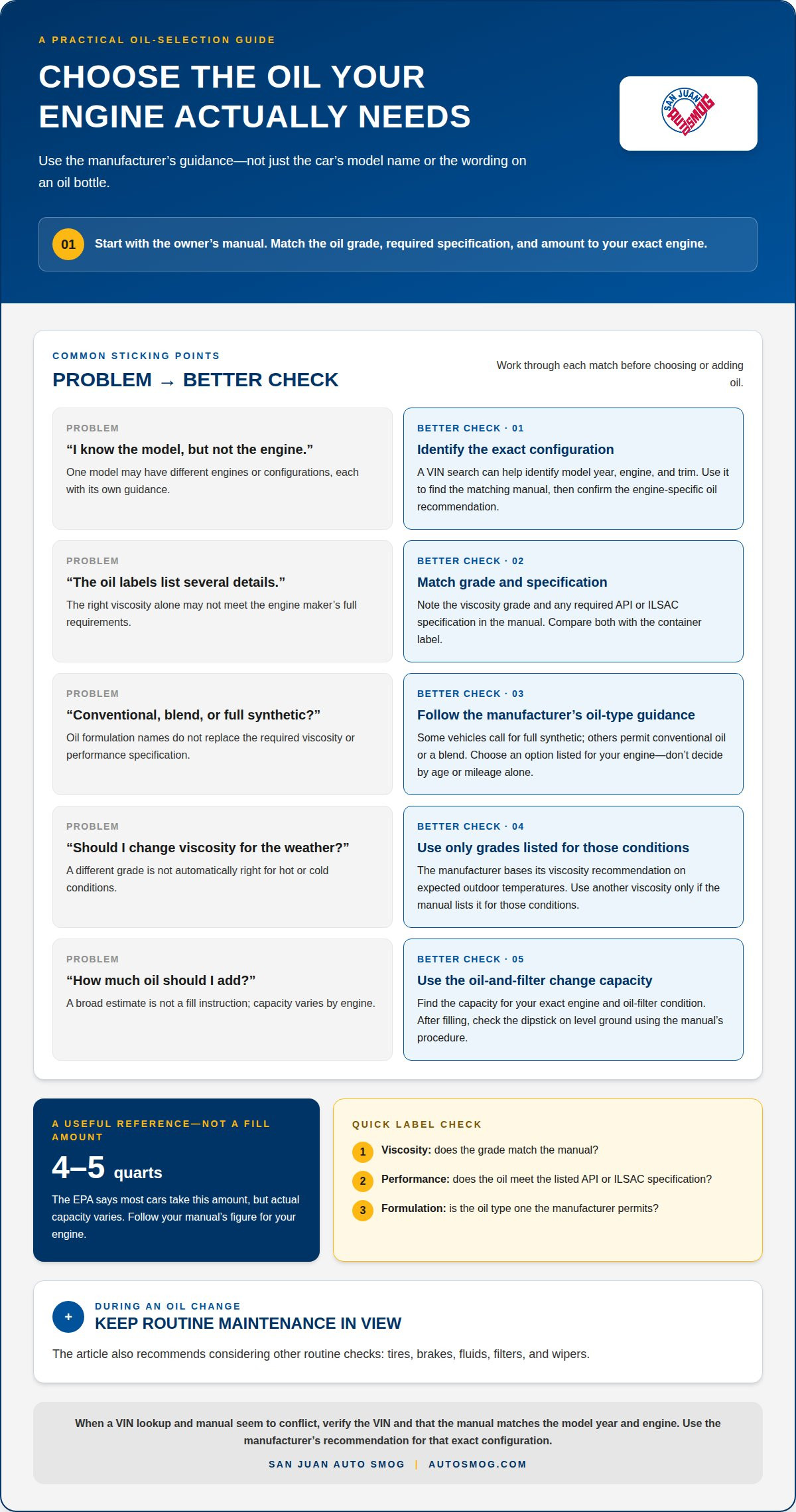
Start with the owner’s manual to find your vehicle’s oil requirements. Look under “Specifications,” “Capacities,” or “Maintenance”; section names vary by manufacturer. Note the engine oil viscosity, required performance specification, and capacity. Match the entry to your engine, especially if the manual lists multiple engines or configurations.
Oil capacity varies by engine. Use the manual’s amount for your engine and oil-filter condition. If it lists separate capacities, choose the figure for an oil-and-filter change. Don’t treat the general range as a fill instruction. After filling, check the dipstick on level ground, following the manual’s procedure.
Some manuals tie the recommended viscosity to the outdoor temperatures expected while the oil is in the engine. Use a different viscosity in hot or cold weather only if the manual lists it for those conditions. Otherwise, use the specified grade. The wrong viscosity or specification may reduce proper lubrication and contribute to engine wear.
Before choosing oil, match the manual’s engine designation to your car’s engine. A paper manual’s index may point to “Engine Oil” or “Capacities”; in a digital manual, search those terms. Record the recommended grade and oil-and-filter change capacity together. That helps you avoid choosing the right oil grade but adding the wrong amount.
FuelEconomy.gov gives an example: using 10W-30 in an engine designed for 5W-30 can lower gas mileage by 1%–2%. It also suggests looking for “Energy Conserving” on the API performance symbol. See its maintenance tips and the American Petroleum Institute’s engine oil program for how the label marks work.
Can I search what kind of oil does my car take by VIN?
Yes, a VIN search can help identify your vehicle’s exact configuration. A manufacturer’s lookup tool may use the VIN to distinguish the model year, engine, and trim. This matters when a model was offered with different engines. A VIN decoder can narrow your search, but may not provide an oil recommendation.
Use the result to find the matching owner’s manual or manufacturer maintenance information. Confirm that the listed engine matches your vehicle, then find the engine-oil entry. Compare the recommended viscosity and required oil specification with the product label. If the manual gives different recommendations for different engines, use the entry for your engine, not just your model name.
Does the required motor oil vary by engine, model year, or trim? Yes. Manufacturers may specify different oil for different configurations, so a model name alone may not identify the right oil. Use the engine-specific information in the manual.
If a VIN lookup and manual seem to conflict, check that you entered the VIN correctly and that the manual matches the model year and engine. Then follow the manufacturer’s recommendation for that exact configuration. Comparing the details helps prevent a broad search result from being mistaken for guidance specific to your vehicle.
Does my car require conventional, synthetic blend, or full synthetic oil?
Conventional, synthetic blend, and full synthetic describe different oil formulations. To answer “what kind of oil does my car need,” start with the manufacturer’s recommendation. Check the manual for the oil type and related requirements. Don’t choose by label alone: the viscosity and required specification must also match your vehicle’s instructions.
Conventional motor oil uses refined petroleum base oils. A synthetic blend combines conventional and synthetic base oils, while full synthetic oil uses synthetic base oils. These categories describe how oils are formulated; they don’t replace the viscosity or performance specification required by the engine maker. If the manual calls for full synthetic, matching only the viscosity isn’t enough.
Some vehicles call for full synthetic, while others permit conventional oil or a blend. Follow the engine maker’s instructions rather than choosing based on age, mileage, or driving preference. If you’re asking “what kind of oil does my car need,” don’t assume an older car needs conventional oil or that synthetic suits every engine. Check the recommendation for your specific engine.
Read the container for the oil type, viscosity, and required performance specification. A bottle marked “synthetic blend” must still meet the manual’s requirements. If the manual allows multiple oil types, choose one of its listed options and follow its maintenance schedule. This keeps your choice tied to the vehicle’s requirements, not a general claim on the label.
What oil specifications and certifications does my car require, such as API or ILSAC?
Oil labels show more than viscosity. API and ILSAC identify performance specifications that may be included in your vehicle’s oil requirements. These details help distinguish oils with the same viscosity grade. Check the owner’s manual for the required specification, then compare it with the information or marks on the oil container.
Keep the requirements distinct as you read: viscosity describes how oil flows, while an API or ILSAC specification indicates performance criteria. For example, a manual may list both a viscosity grade and an API category. Both matter. Matching the viscosity alone doesn’t confirm that the oil meets the specified performance requirement.
Use this simple comparison when choosing a container:
- Find the oil requirements in the manual’s engine-oil section.
- Note the viscosity grade and any API or ILSAC specification listed.
- Compare those details with the container label before purchase.
Don’t assume a newer-sounding category automatically suits an older vehicle. Follow the manufacturer’s instructions for your engine and model year. If the manual lists more than one acceptable specification, choose an oil that meets one of them. A product description that says “for all vehicles” doesn’t replace checking the listed requirements.
For a clear choice, use the manual as your reference and the container to confirm the match. Check viscosity and specification together, even if the oil type seems familiar. This label check helps you avoid choosing a product that meets one requirement but misses another listed for your vehicle.
What other maintenance should I consider during an oil change?
An oil change is a practical time to review other routine maintenance. A fluid check can identify changes in fluid levels or visible condition, including coolant, brake fluid, and transmission fluid. Each fluid has a specific role, so follow your vehicle’s maintenance schedule instead of topping everything off automatically. The correct fluid and service timing depend on the vehicle.
Tire rotation can help address uneven tread wear, but the pattern depends on tire type and drivetrain. A brake inspection can check visible components for wear or other concerns. If braking feels different or you hear a new noise, mention the symptom so it can be assessed during the inspection.
Air filters also need attention. A dirty engine air filter can restrict airflow, while a cabin filter helps filter air entering the passenger area. Condition and replacement timing vary by vehicle and use. Check windshield wipers for streaking, tearing, or poor contact, since clear visibility matters in the rain.
A multi-point inspection can bring these checks together and help organize maintenance priorities. It gives you a broader view of fluid condition, tires, brakes, filters, and wipers while the vehicle is being serviced. Ask which items need attention now and which can wait according to the manufacturer’s schedule. That makes an oil change a useful checkpoint for ongoing vehicle care, not just an oil replacement. At San Juan Auto Smog, a multi-point inspection, fluid check, and tire rotation are optional add-ons, not part of the oil change.
San Juan Auto Smog
San Juan Auto Smog can help you put your vehicle’s oil recommendation into practice when maintenance is due. If your manual calls for full synthetic oil, the Full-Synthetic Oil Change is a practical next step. San Juan Auto Smog offers full-synthetic oil changes, with a multi-point inspection, fluid check, and tire rotation available as options. The recommendation remains specific to your vehicle, so bring the manual or the vehicle details you used to identify its requirements.
Keeping up with oil service supports engine performance and reliability, but an oil change alone does not ensure a vehicle will pass a California smog inspection. As a STAR-certified Test & Repair station (License # RC 303707) at 4701 San Juan Ave, Fair Oaks, CA 95628, San Juan Auto Smog can also diagnose a vehicle that fails, handle emissions-related repairs, and retest it. If both services are due, having them handled during one visit can help organize routine maintenance. San Juan Auto Smog serves drivers in Fair Oaks, Carmichael, Sacramento, Citrus Heights, Orangevale, and Gold River.
San Juan Auto Smog also performs STAR-Certified Smog Checks and Older Vehicle Smog Checks for 1999 and older vehicles; the BAR Smog Check Program explains how inspections work. RV, van, and heavy truck smog checks are available by appointment. Choose the inspection that fits your vehicle and keep its maintenance needs separate from its emissions test.
For an oil change, the owner’s manual provides the required grade and amount. For a smog visit, have your vehicle information ready so the appropriate inspection can be identified. Keeping these details together makes it easier to plan routine care and emissions testing.
Contact San Juan Auto Smog to schedule an oil change or smog check. Please book ahead. Text (916) 961-6009 to make an appointment.
Frequently Asked Questions
Where can I find what oil my car takes?
Check the owner’s manual or the vehicle manufacturer’s owner-information resources. If you’re buying a used car without its manual, identify the exact model year and engine before searching. A previous service invoice or reminder sticker may show what oil was used last time, but that doesn’t establish that it’s the right oil for your vehicle.
How do I find the correct oil type and viscosity for my car?
First identify the engine configuration, especially if the model was sold with different engines. Then use the matching manufacturer information to check the oil requirements. For a used vehicle, don’t assume a previous owner’s choice was correct. Compare the specifications with the container label, and keep a photo of the relevant manual entry for future purchases.
Where can I find my car's oil requirements in the owner's manual or oil cap?
Use the manual’s index to find the engine-oil entry, or search its digital version for “oil.” The filler cap can provide a quick reminder, but may show only a grade, not the complete requirements or oil capacity. If the cap and manual differ, use the vehicle-specific manufacturer information as your reference.
What engine oil viscosity does my car need, such as 0W-20 or 5W-30?
The correct grade is the one specified for your engine. In labels such as 0W-20 and 5W-30, the two parts describe oil-flow behavior at different temperatures. The numbers are not a ranking where a higher grade is automatically better. Treat these grades as examples, and don’t select one based solely on another vehicle’s recommendation.
More articles
- Who Does STAR Certified Smog Checks Near Carmichael?
- What paperwork do I need for a smog check, and how long will it take?
- How Long Does a Smog Check Take at the Inspection Station?
- Older Car Oil Change Frequency in Citrus Heights: When to Change Your Oil
- Which Warranty Covers an Oil Change? Quiz Answer Explained
- Do Hybrid Cars Need Smog Checks in California? The Rules