What paperwork do I need for a smog check, and how long will it take?

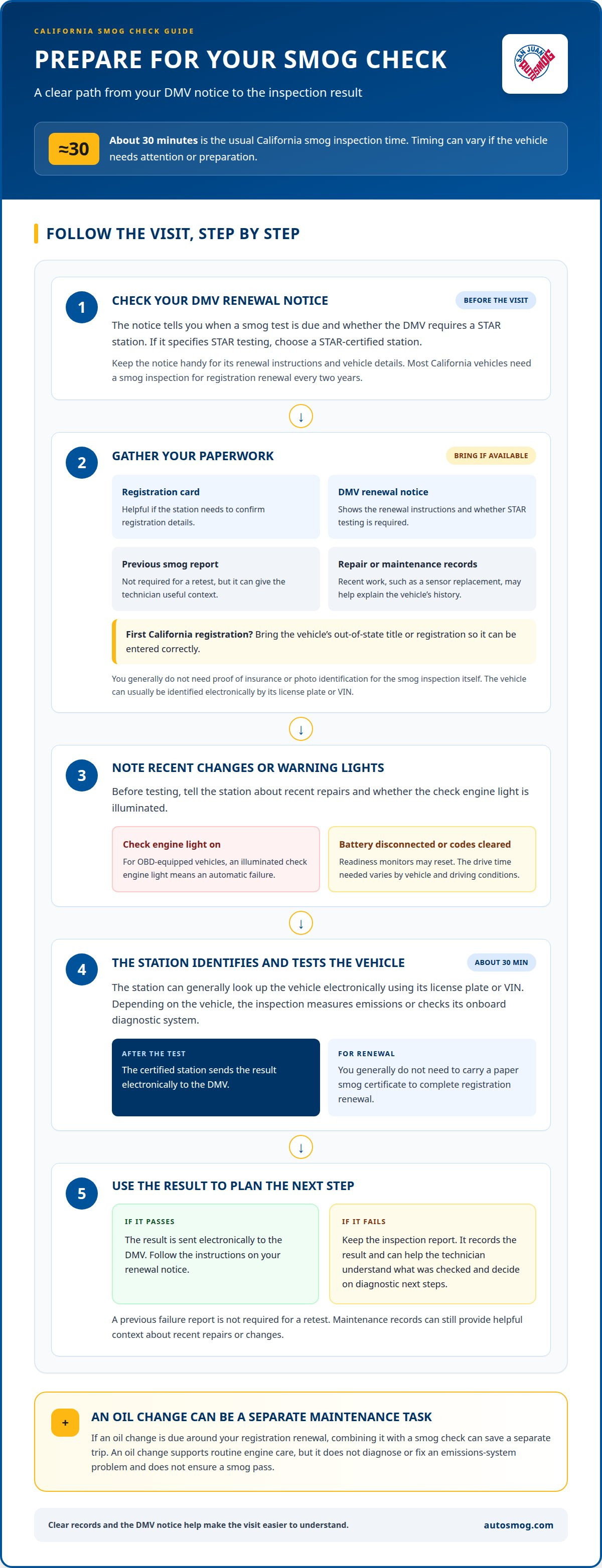
Will a smog check take all morning? If you’re wondering what paperwork you need for a smog check, the vehicle is generally enough for the test; bring your DMV registration renewal notice if it’s available. A California smog inspection usually takes about 30 minutes. Check with the station before you go to confirm what documents to bring.
It’s reasonable to want a clear plan before you head to a station, especially if a registration deadline or sale is involved. This guide explains what to bring, what can affect test time, and what happens if the vehicle doesn’t pass. You’ll also learn when California sellers need a smog certification and why maintenance records can help identify potential problems after a failed test. A little preparation can make the visit more straightforward and help you understand your next step, whether you’re renewing registration or getting ready to sell.
Key Takeaways
- Your registration details help the smog station identify the vehicle and connect the inspection to its renewal.
- If the vehicle fails, the test report and maintenance history can help clarify what needs attention before the next step.
- Pairing a smog check with an oil change and routine maintenance can make it easier to keep up with vehicle care, though an oil change alone does not ensure a pass.
- If you’re selling a car, understand when certification is required and how long the certificate remains valid.
Table of Contents
How a smog station uses your registration renewal notice and VIN
For a California smog inspection, the vehicle is generally the only item needed, because a station can look it up electronically by license plate or VIN. Still, bring your registration card and renewal notice if available; registration details can be helpful, though the station can generally identify the vehicle electronically.
Your DMV renewal notice helps explain why a test is due and whether the DMV requires a STAR station. If it specifies STAR testing, choose a STAR-certified station to meet that requirement. Keep the notice handy during registration renewal by mail or in person, since it includes renewal instructions and details.
Most California vehicles need a smog inspection as part of registration renewal every two years. After the test, a certified station sends the result electronically to the DMV, so you generally don’t need to carry a paper certificate to complete renewal. If you’re renewing by mail, follow the instructions on your DMV notice. For an in-person renewal, bring the notice and your registration information to help identify the vehicle and renewal.
You don’t need proof of insurance or photo identification for the smog inspection itself. Those documents are separate from the test. If your DMV notice requires a STAR station, the station uses the vehicle’s identifying information to connect the inspection with that requirement. Registration smog testing is also different from the certification timing that applies to a vehicle sale.
What happens if my vehicle fails the smog check?
If the vehicle doesn’t pass, the next step is diagnosis and repair. San Juan Auto Smog is a STAR-certified Test & Repair station (License # RC 303707), so the same shop can diagnose the cause, handle emissions-related repairs, and retest the vehicle.
If the vehicle fails, keep the inspection report. It records the result and can help diagnose emissions problems. A previous failure report isn’t required for a retest, but it gives the technician useful context about what was checked. Maintenance records can also show recent repairs or changes that may affect testing.
California requirements depend on vehicle type and registration details, not just the county name. The DMV renewal notice indicates when a test is due and whether testing at a STAR station is required. Most vehicles need a Smog Check every two years, as the DMV explains. Gasoline, hybrid, and alternative-fuel vehicles from model year 1976 onward generally need testing; diesel vehicles from model year 1998 onward generally need it.
Military status alone does not determine whether a vehicle needs a California smog inspection. Bring your renewal notice and registration information, along with maintenance or prior test records if available. Proof of insurance and photo identification aren’t required for the inspection. For OBD-equipped vehicles, an illuminated check engine light means an automatic failure; BAR’s Smog Check Program explains how the inspection works. After testing, a technician can explain the result and next steps.
What should I bring to a California smog check?
For a California smog inspection, bring your vehicle registration and DMV renewal notice if available. The station can usually identify the vehicle electronically, but registration details can help resolve a mismatch. You don’t need proof of insurance or photo identification. These documents give the station a useful starting point.
Bring a previous smog report and recent repair or maintenance records if you have them. For example, a receipt for a sensor replacement can give the technician useful context. If the battery was disconnected or replaced, readiness monitors may need drive cycles to reset. The time this takes varies by vehicle and driving conditions.
If you’re registering a vehicle in California for the first time, bring its out-of-state title or registration so it can be entered correctly. For a visit within California, your registration and renewal notice help identify the vehicle’s current registration details.
Before testing, note any recent repairs and whether the check engine light is illuminated. For OBD-equipped vehicles, an illuminated check engine light means an automatic failure. Battery disconnection, cleared diagnostic codes, and repairs can also reset readiness monitors, even when the light is off. If the vehicle has failed before, keep the report with its records. It isn’t required for a retest, but it can help explain the earlier result and inform the next diagnostic steps.
Can I combine a smog check with an oil change?
Yes. Combining a smog check and oil change in one visit can save a separate trip and make routine vehicle care easier to organize. If an oil change is due around the time of your registration renewal, handling both together can help keep these tasks on schedule.
An oil change supports engine lubrication and routine operation, but it doesn’t diagnose or fix an emissions-system problem. An oil change alone won’t make a vehicle pass its smog test. Depending on the vehicle, the inspection measures emissions or checks its onboard diagnostic system.
Routine maintenance still matters over time. Following the vehicle manufacturer’s oil-change schedule helps maintain engine performance and reliability. A professional oil change can be paired with an optional fluid check, multi-point inspection, or tire rotation when you want a broader look at maintenance needs.
For older or high-mileage vehicles, organized maintenance records can help you track recurring needs and explain recent service. If a warning light is on or the vehicle has failed an inspection, that concern needs to be assessed separately. An oil change doesn’t replace diagnosis or emissions repairs. Clear findings help distinguish routine maintenance from work related to the test.
Plan your visit around both the registration deadline and the vehicle’s maintenance schedule. This supports routine care without treating an oil change as a shortcut to passing a smog test.
Smog certification when selling a car
For a private vehicle sale in California, plan to obtain smog certification before transferring ownership. A passing inspection provides the buyer with current emissions-test information and helps keep the transfer organized. A DMV renewal notice may indicate that testing is due, but a sale certificate has its own validity period.
A smog certificate for a California vehicle sale is valid for 90 days, according to the California Bureau of Automotive Repair’s Smog Check Program. Schedule the inspection close enough to the sale that the certificate remains valid when ownership transfers. If the sale takes longer, the certificate may no longer be current for that transaction.
California sellers generally provide a valid smog certification to the new owner. A vehicle less than four years old does not require a smog inspection when sold, but the new owner must pay a smog transfer fee, according to the California DMV’s smog inspection page. This exemption is based on the vehicle’s age, so confirm the model-year details during the sale.
After testing, a certified California station submits the result electronically to the DMV. The buyer and seller can discuss the passing result as part of the transfer, while the DMV receives the inspection record directly. Keep the sale timing, vehicle registration details, and any renewal notice together so the test is matched to the correct vehicle. A warning light or emissions problem may prevent a passing result, so allow time for diagnosis and any necessary repairs before completing the sale.
San Juan Auto Smog
San Juan Auto Smog provides STAR-certified smog checks in Fair Oaks for registration renewals and vehicle sales. Bring your registration and renewal notice if available. If the vehicle has failed before, its test report can give the technician useful context. These documents help connect the inspection to the right vehicle and clarify why testing is due.
San Juan Auto Smog offers a STAR-certified smog check for model year 2000 and newer vehicles. If your notice directs you to a STAR station, a STAR-certified inspection can address that requirement. Vehicles from 1999 and earlier have a separate older-vehicle smog check. RV, van, and heavy truck inspections are also available by appointment.
As a Test & Repair station at 4701 San Juan Ave, Fair Oaks, CA 95628, the shop can also diagnose and repair a vehicle that fails, then retest it. After the emissions test, consider maintenance based on the vehicle’s needs. San Juan Auto Smog offers full-synthetic oil changes, with a multi-point inspection, fluid check, and tire rotation available as options. A full-synthetic oil change supports routine engine care, but it doesn’t replace emissions diagnosis or ensure a passing result. The inspection result and maintenance history can help distinguish scheduled service from an emissions concern, making it easier to plan the next step.
Whether you’re in Fair Oaks or a nearby community, having the notice and vehicle details ready helps keep the visit organized. The right service depends on the vehicle type and the reason for testing.
Contact San Juan Auto Smog to discuss your smog inspection. Please book ahead. Text (916) 961-6009 to make an appointment.
Frequently Asked Questions
How Long Will It Take?
Allow for more than the inspection itself. A station queue or incomplete readiness monitors can add time before testing is complete. Readiness monitors are emissions-system self-checks, and battery work or cleared diagnostic codes can interrupt them. Mention recent battery work at check-in so the technician can explain whether testing can proceed.
If I sell my car, do I have to get it inspected first?
For a private sale in California, the seller generally handles required smog certification before transferring ownership. If the vehicle needs emissions-related repairs after testing, include that work in the sale timeline rather than arranging an immediate handoff. Keep the smog result with the sale papers, and treat the emissions record and title-transfer documents as separate records for the buyer and seller.
Should You Bring Anything Else?
Arrive with the engine warmed up by driving the vehicle for a while before testing. This helps bring the engine and emissions systems to operating temperature. If the vehicle recently had battery work, mention it at check-in because readiness monitors may still be completing their self-checks. This detail can help the technician interpret the vehicle’s test readiness.
What documents are required for a smog check in the United States?
There isn’t one document list for every emissions test in the United States. Requirements depend on the vehicle’s registration jurisdiction and local testing rules. Start with the renewal instructions for the state where the vehicle is registered, then bring the registration information those instructions identify. Moving across state lines can change which inspection rules apply after registration changes.
Is proof of insurance or photo ID required for a smog check?
No. California smog inspections don’t require proof of insurance or photo identification. These documents don’t determine the emissions test result. If you have them, they don’t replace vehicle information or service records that may help explain recent work. For example, a repair receipt can show what was addressed before inspection.
What paperwork is needed for a smog check when buying or selling a car?
Keep the smog result with the ownership-transfer paperwork, but treat the emissions record and title transfer as separate documents. For a California family transfer (spouse, domestic partner, sibling, child, parent, grandparent, or grandchild), an inspection generally isn’t required, per the DMV. An exception applies if a relative bought the car for the recipient without first titling it in their own name. That distinction can affect the transfer paperwork.
More articles
- Who Does STAR Certified Smog Checks Near Carmichael?
- How Long Does a Smog Check Take at the Inspection Station?
- Older Car Oil Change Frequency in Citrus Heights: When to Change Your Oil
- Which Warranty Covers an Oil Change? Quiz Answer Explained
- Do Hybrid Cars Need Smog Checks in California? The Rules
- Smog Repair in Sacramento: What Happens After a Failed Test