Do Hybrid Cars Need Smog Checks in California? The Rules

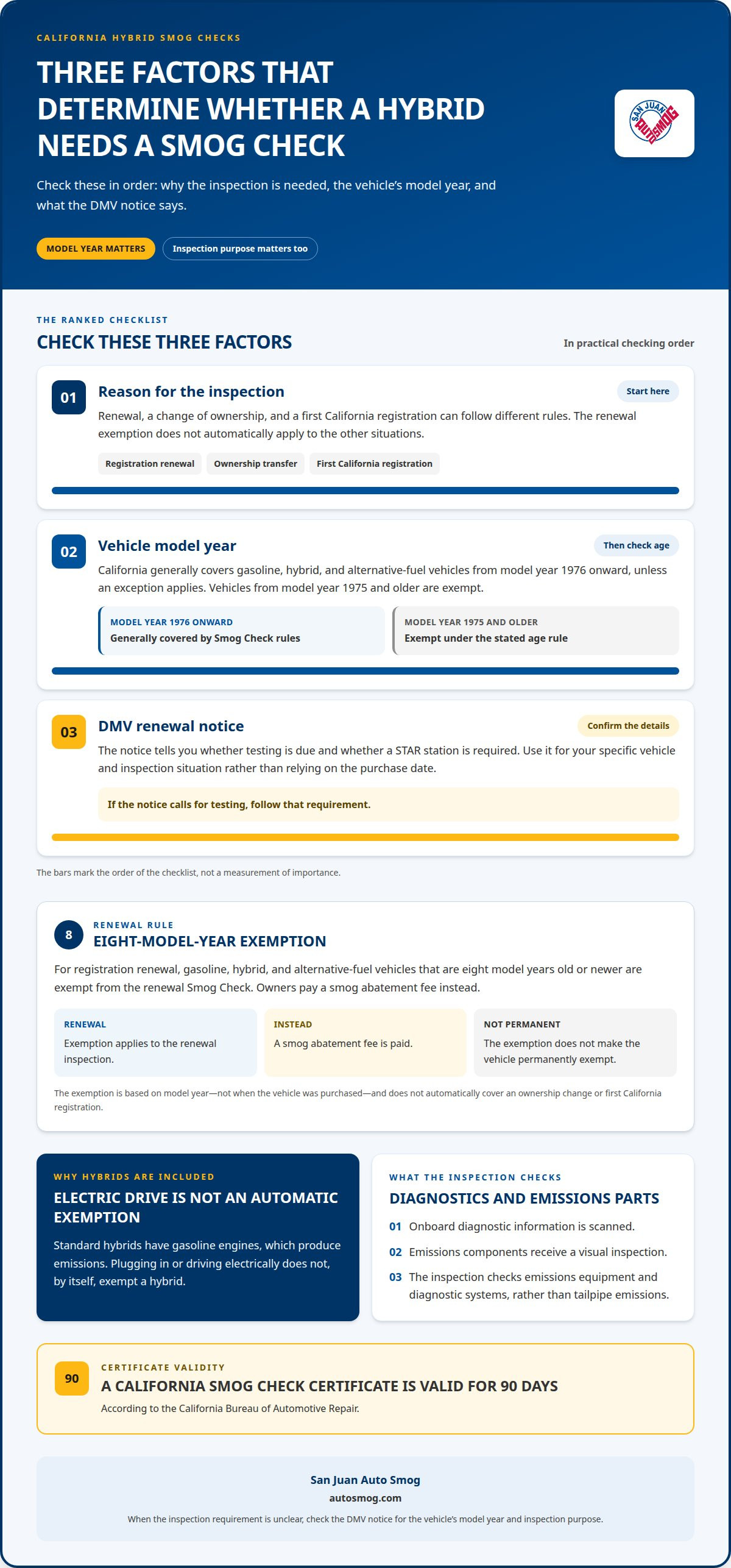
Do hybrid cars need smog checks in California? Yes, many do. California’s Bureau of Automotive Repair says gasoline, hybrid, and alternative-fuel vehicles from model year 1976 onward need a Smog Check unless an exception applies. The California Department of Motor Vehicles says vehicles eight model years old or newer are exempt from the renewal inspection, but owners pay a smog abatement fee instead.
It’s understandable to think a hybrid’s electric motor might exempt it from emissions testing. But standard hybrids also have gasoline engines, so the model year and reason for the inspection matter. A renewal inspection isn’t the same as a check required for a change of ownership or a first California registration.
This guide explains which hybrid and other vehicles need a California Smog Check, how the model-year rules work, and when the renewal exemption applies. You’ll also learn what a hybrid inspection checks and how it differs from a conventional tailpipe test, so you know what to expect before registration or a vehicle transfer.
Key Takeaways
- Use your vehicle’s model year and the reason for inspection to understand whether a Smog Check may be required.
- Learn how the renewal exemption works and what replaces the inspection during eligible years.
- See why hybrids are tested and how their inspection differs from a conventional tailpipe test.
- Pair a smog visit with an oil change and routine maintenance to make better use of your time.
Table of Contents
What Are California's Hybrid Vehicle Smog Check Regulations?
California generally applies gasoline-vehicle Smog Check rules to hybrids, with exemptions depending on model year and inspection purpose. The inspection checks emissions components and onboard diagnostic information, rather than tailpipe emissions.
Hybrid Smog Check Requirements
A hybrid Smog Check evaluates the vehicle’s emissions equipment and diagnostic system. Standard hybrids are included because their gasoline engines produce emissions. The Bureau of Automotive Repair’s OBD Inspection System scans onboard diagnostics and includes a visual inspection of emissions components. A licensed station can test a hybrid unless the DMV renewal notice requires a STAR station. A smog certificate issued after a California Smog Check is valid for 90 days, according to the California Bureau of Automotive Repair.
Requirements by Hybrid Type
Standard hybrids and plug-in hybrids generally follow the same rules as gasoline vehicles of the same model year. Plugging in or driving electrically doesn’t by itself exempt a hybrid. Hybrids more than eight model-years old generally need a renewal check, while those more than four model-years old require one when ownership changes. In short, hybrids need a Smog Check when the applicable model-year and inspection rules require one.
Checking Whether an Inspection Is Needed
Start with the vehicle’s model year and the reason for inspection: renewal, ownership transfer, or first California registration. The DMV notice states whether testing is due and whether a STAR station is required. Requirements can depend on the vehicle and inspection circumstances, so check the notice for your specific case. Use the notice to confirm the requirement for your vehicle. California Smog Check requirements also depend on the inspection circumstance.
Model-year coverage for gasoline, hybrid, and alternative-fuel vehicles
Model year is a useful starting point, but the inspection reason and vehicle type matter too. California’s broad coverage rules include specific exemptions.
Newer Vehicle Renewal Exemptions
For registration renewal, California exempts gasoline, hybrid, and alternative-fuel vehicles that are eight model years old or newer from a Smog Check, according to the California Department of Motor Vehicles. Owners pay a smog abatement fee instead. This exemption is tied to renewal, so don’t assume it applies to other inspection situations. A vehicle brought into California for its first registration may still need testing, even if it is newer.
Age and Inspection-Type Exemptions
California requires gasoline, hybrid, and alternative-fuel vehicles from model year 1976 and newer to have a Smog Check unless an exception applies, according to the California Bureau of Automotive Repair. Gasoline, hybrid, and alternative-fuel vehicles from model year 1975 and older are exempt. For a transfer, the DMV says a vehicle less than four model years old does not need a change-of-ownership inspection; the new owner pays a smog transfer fee instead. That differs from the renewal exemption.
First-time California registration has a separate rule: vehicles previously registered in another state require a Smog Check for registration in California. The renewal exemption doesn’t automatically remove that requirement. The inspection type and registration history matter, as well as the model year.
A Smog Check exemption tells you whether testing is required; it doesn’t establish eligibility for repair assistance or vehicle retirement. Those programs have separate criteria. If a vehicle fails testing, its condition and the relevant program requirements matter. Keep the renewal notice with the registration details to clarify which inspection circumstance applies.
Eight-model-year renewal exemption
California’s eight-model-year exemption applies to registration renewal for gasoline, hybrid, and alternative-fuel vehicles. The California Department of Motor Vehicles says owners of eligible vehicles pay a smog abatement fee instead of getting a renewal Smog Check. The exemption changes what’s required for that renewal cycle; it doesn’t make the vehicle permanently exempt from emissions testing.
The exemption is based on model year, not when you bought the vehicle or became its owner. For example, a vehicle’s model year determines where it falls in the renewal cycle, even if you purchased it later. During the exempt period, vehicles skip the renewal-cycle inspection and pay the abatement fee. After that exempt period, a Smog Check is generally required for renewal unless another exception applies.
Read the DMV renewal notice carefully. It tells you whether a Smog Check is required for that registration renewal, helping distinguish a testing requirement from the abatement fee. If the notice calls for testing, the eight-model-year exemption doesn’t remove that requirement. The notice is more useful than relying on the purchase date or assuming all newer vehicles are treated alike.
The exemption is specific to renewal, so don’t apply it automatically to an ownership change or first California registration. Those situations have separate rules. A vehicle can also have emissions-control concerns regardless of whether its current renewal requires testing. The California Bureau of Automotive Repair explains the state’s Smog Check Program; use your vehicle’s model year and DMV notice to understand the renewal requirement.
Why hybrids are included in California's Smog Check Program
Hybrids use electric power, but a standard hybrid also has a gasoline engine. Burning gasoline produces emissions, so a vehicle isn’t emissions-free just because its electric motor can assist with driving. That’s why California includes eligible hybrids in its Smog Check Program. The relevant question is whether the vehicle has an emissions-producing engine, not how often it uses electric power.
A hybrid’s gasoline engine may operate at different times, depending on how the vehicle is designed and running. When it does, emissions-control components help manage exhaust. Those components remain relevant even when the electric motor handles some driving. The battery and motor change how the vehicle uses energy; they don’t eliminate the gasoline engine’s emissions-control needs.
Hybrid ownership doesn’t automatically mean exemption. A fully electric vehicle has no gasoline engine, while a hybrid retains one. California’s rules account for that difference. Whether a particular hybrid needs a check depends on the applicable model-year and inspection rules, not on how often the driver estimates it runs on electricity.
The practical answer to “do hybrid cars need smog checks in California?” is yes, when the vehicle falls under the state’s testing rules. A hybrid’s lower gasoline use doesn’t determine whether testing applies. The requirement depends on the vehicle’s classification and circumstances, not on whether the driver can select electric operation or charge the battery.
So, “do hybrid cars need smog checks in California?” The gasoline engine is the central reason they can. Smog requirements recognize that hybrid vehicles combine electric propulsion with fuel-burning operation. Owners can think of the battery as supporting the powertrain, not replacing its emissions responsibilities. That distinction helps explain why hybrids are covered while fully electric vehicles follow a different exemption.
San Juan Auto Smog
San Juan Auto Smog helps California drivers understand inspection requirements and receive the appropriate smog check. Located in Fair Oaks, it serves drivers from nearby Carmichael, Sacramento, Citrus Heights, Orangevale, and Gold River. As a STAR-certified Test & Repair station (license RC303707) at 4701 San Juan Ave, Fair Oaks, CA 95628, it can meet a DMV notice that requires a STAR station with a STAR-Certified Smog Check, and it can also handle repairs if a vehicle fails. Please book ahead.
Combining an emissions inspection with routine maintenance can make vehicle care easier to organize. If an oil change is due as well, handling both during one visit can save a separate trip. San Juan Auto Smog offers full-synthetic oil changes, with a multi-point inspection, fluid check, and tire rotation available as options. A Full-Synthetic Oil Change supports engine performance and reliability, but an oil change alone doesn’t make a vehicle pass its Smog Check. The emissions inspection evaluates emissions-related systems separately.
Older vehicles may need an inspection suited to their age. San Juan Auto Smog provides Older Vehicle Smog Checks for 1999 and older models, along with inspections for RVs, vans, and heavy trucks. For a hybrid, the inspection requirement still depends on the vehicle and the reason for testing. The service helps drivers address the inspection without treating routine maintenance as a substitute for emissions testing.
Routine maintenance is separate from emissions testing. An oil change supports engine maintenance, while a Smog Check assesses emissions compliance. Drivers in Fair Oaks, Carmichael, Sacramento, Citrus Heights, Orangevale, and Gold River can handle a smog check and full-synthetic oil change with San Juan Auto Smog. Each service addresses a distinct need, without unnecessary additions.
For help with your California hybrid or another vehicle, contact San Juan Auto Smog. Text (916) 961-6009 to make an appointment.
Frequently Asked Questions
Is a hybrid inspected differently than a regular gas car?
A hybrid is inspected through its onboard diagnostic system along with visual and functional checks of emissions equipment, rather than a tailpipe test. Check whether your DMV notice directs you to a STAR station. An illuminated check-engine light means a vehicle won’t pass its Smog Check, so address warning-light concerns before the inspection to ensure its diagnostic status can be evaluated accurately.
Are hybrids required to have a tailpipe emissions test?
No. A hybrid Smog Check doesn’t include a tailpipe emissions test. If the vehicle’s battery has been disconnected or replaced, readiness-monitor reset time varies by vehicle and driving conditions. Check the manufacturer’s guidance or ask a qualified technician when the vehicle may be ready for testing. These monitors are part of the onboard diagnostic system, so their status matters during inspection.
What about a plug-in hybrid, doesn’t it count as electric?
No. A plug-in hybrid is still a hybrid, not a fully electric vehicle, because it also has a gasoline engine. For a private-party sale, the seller must provide a valid smog certification. An immediate-family transfer is an exception to the Smog Check requirement, so the type of transfer matters as well as the powertrain.
Which types of hybrids will be required to receive a Smog Check?
Standard and plug-in hybrids may require testing when California’s model-year and inspection rules apply. A private-party sale is separate from registration renewal: the seller must provide a valid smog certification for the transfer. Non-approved aftermarket emissions equipment can also cause a vehicle to fail, whether it’s a standard or plug-in hybrid.
Which California hybrids are exempt from smog checks based on model year or fuel type?
Gasoline, hybrid, and alternative-fuel vehicles from model year 1975 and older are exempt. Fully electric vehicles are exempt in every model year. An immediate-family vehicle transfer is also exempt from the Smog Check requirement. These exceptions differ, so identify whether the question involves the vehicle’s age, fuel type, or transfer circumstances.
How often must a hybrid car pass a California smog check?
When no exemption applies, hybrids generally need a Smog Check every other year for registration renewal. The renewal notice indicates whether testing is due for that cycle. Ownership changes have separate rules, so the renewal interval doesn’t cover every situation. For a sale, the relevant question is whether the required certification is valid for the transfer.
Drivers in Fair Oaks, Carmichael, Sacramento, Citrus Heights, Orangevale, and Gold River can schedule a smog check with San Juan Auto Smog. Text (916) 961-6009 to make an appointment.
More articles
- How Long Does a Smog Check Take at the Inspection Station?
- Older Car Oil Change Frequency in Citrus Heights: When to Change Your Oil
- Which Warranty Covers an Oil Change? Quiz Answer Explained
- Smog Repair in Sacramento: What Happens After a Failed Test
- Winter car prep checklist for Carmichael drivers: battery and brakes
- Best Smog Shop for Quick Turnaround in Orangevale