Will Using an Independent Mechanic Void Your Warranty?

An independent mechanic can service your car without automatically voiding its factory warranty. If you’re asking whether using an independent mechanic will void your warranty, the general answer is no: a manufacturer or dealer generally cannot deny coverage solely because you chose a shop outside its dealership network. However, a warranty may not cover damage caused by faulty work, and required maintenance still matters.
It’s understandable to want a clear answer before booking service, especially when warranty terms can sound restrictive. This guide explains when a manufacturer may require a selected repair facility for work covered by the warranty, how to keep useful service records, and what to do if a claim is denied. You’ll also learn how DIY maintenance and aftermarket parts can affect a claim, and why following the maintenance schedule in your owner’s manual can help protect your coverage.
Key Takeaways
- Independent shop service alone doesn’t void factory warranty coverage, but damage linked to faulty work may not be covered.
- Keep itemized service records and receipts so you can show what maintenance was done and when.
- If a warranty claim is denied, ask for the reason in writing and use the stated cause of the problem to guide your response.
- Follow the maintenance schedule in your owner’s manual, and choose oil that meets your vehicle manufacturer’s specifications when you schedule an oil change at San Juan Auto Smog.
Table of Contents
Is My Factory Warranty Void if I Don’t Service My Car at the Dealership?
No. In the United States, choosing an independent mechanic does not automatically void your factory warranty. The Magnuson-Moss Warranty Act, a federal consumer protection law passed in 1975, makes it illegal for a manufacturer or dealer to deny coverage solely because maintenance or repairs were done outside a dealership. The U.S. Government Publishing Office also explains that a warrantor generally cannot require a named service or product unless it is provided without charge under the warranty.
That protection does not mean every repair bill is covered. A manufacturer may deny coverage for damage caused by faulty work, such as engine damage after an oil filter was not reinstalled. It may also deny a claim involving an aftermarket or recycled part if the defective or incorrectly installed part caused the need for repair. Using such a part alone is not enough to deny coverage. A dealer or manufacturer may also direct you to selected facilities for repairs fully covered by the warranty.
There is no fixed cost difference between dealership and independent mechanic service. The amount depends on the vehicle, the maintenance or repair involved, the parts, and the labor. Compare estimates for the same work and scope.
Can a warranty claim be denied if an independent mechanic caused the damage? Yes. The denial should relate to the damage caused by the mechanic’s faulty work, not simply the fact that you used an independent shop.
Vehicle modifications require the same attention to cause and effect. A modification does not automatically cancel every factory warranty benefit, but a claim may be denied when the modification caused the failure or resulting damage. For example, an incorrectly installed aftermarket component that damages a related system could affect coverage for that repair. Skipping scheduled maintenance or using the wrong part can also create problems if it contributes to a failure. Follow the maintenance schedule in your owner’s manual, and keep service records showing what work was done.
Keeping maintenance records
Keep records for every maintenance or repair visit, whether you use a dealership, an independent shop, or do the work yourself. If a warranty question comes up, dated records can help show what was done and whether it followed the maintenance schedule in your owner’s manual. The schedule varies by vehicle make, model, and year, so use the manual for your specific car rather than a general checklist.
For each service, save the invoice or receipt and make sure it identifies the vehicle and work performed. A useful record connects the maintenance to a date and odometer reading. Keep supporting documents together, including receipts for parts and fluids bought for DIY work. If an invoice says only “service,” ask for a clearer description of the task and materials before filing it.
- Record the service date and odometer reading.
- Keep the repair order or receipt describing the work.
- Save parts and fluid receipts for work you perform yourself.
- Note any inspection findings and recommended follow-up.
- Store paper copies together and keep digital copies as backup.
Organize records by date, then match each visit to the maintenance interval in your owner’s manual. For example, an oil-change receipt should identify the service performed, not just show a payment. If a repair follows earlier maintenance, keep both invoices together; the sequence can help explain what changed and when. Keep records even when everything is working, since a warranty claim may arise later.
A multi-point inspection can help document observed maintenance needs alongside routine service records. Keep any resulting findings with the related invoice, so you can track what was noted and what work followed. A tidy file makes it easier to answer questions about a specific repair without relying on memory.
Responding to a denied warranty claim
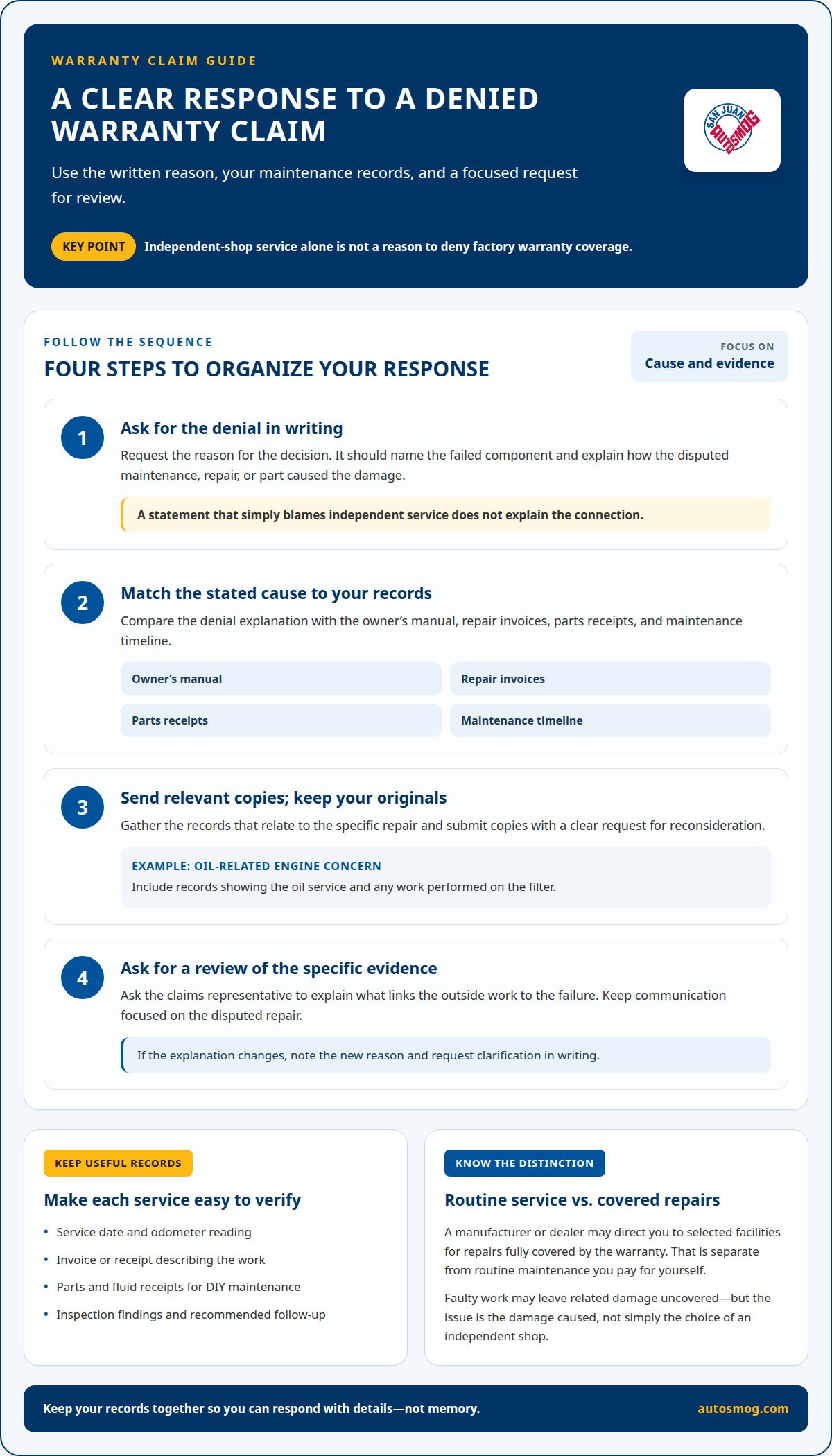
A denied claim is not automatically justified just because an independent shop serviced your vehicle. Start by asking the manufacturer or dealer for the denial reason in writing. The explanation should identify the failed component and explain how the disputed maintenance, repair, or part caused the damage. A statement that simply blames independent service does not explain that connection.
Use the denial letter to organize your response. Compare its stated reason with your owner’s manual, repair invoices, parts receipts, and maintenance timeline. If the claim concerns an oil-related engine problem, for example, gather records showing the oil service and any work on the filter. Send copies, keep your originals, and ask the claims representative to review the specific evidence.
- Request the written denial and the reason for the decision.
- Identify the failed part and the alleged cause of its failure.
- Gather relevant invoices, receipts, and maintenance records.
- Submit the records with a clear request for reconsideration.
Keep communication focused on the disputed repair. Ask the manufacturer or dealer to explain what evidence links the outside work to the failure. For independent repair work in California, the Bureau of Automotive Repair’s auto-repair guide explains your right to a written estimate and an itemized invoice, both useful records in a dispute. If the explanation changes, record the new reason and request clarification in writing. This helps distinguish a claim about actual damage from a blanket objection to the repair facility.
Warranty-covered repairs can have different facility rules. A manufacturer or dealer may require you to use selected repair facilities when the work is fully covered by the warranty. That is separate from routine maintenance you pay for yourself. Review the claim instructions and authorization before arranging covered repairs, so the work follows the warranty process.
If a dealership employee says all service must be done there to preserve your warranty, raise the concern with the dealership and manufacturer. The Federal Trade Commission says consumers can also file a complaint with the FTC about that statement. The FTC’s consumer guide, Auto Warranties, Routine Maintenance, and Repairs, explains these rights in plain language. Keep the employee’s name, date, and exact wording with your correspondence. A written record makes it easier to describe what was said and how the dealership responded.
What If I Perform My Own Maintenance?
You can do routine maintenance yourself, using your owner’s manual as the vehicle-specific guide. It explains the maintenance schedule for your make, model, and year. A general online checklist may not match your vehicle. Before starting a task, identify the required procedure, parts, and fluids in the manual. If a job falls outside your experience or tools, using a qualified shop can help avoid mistakes.
For an oil change, record the date, odometer reading, oil specification, filter information, and work completed. Save receipts for the products you used. For a fluid check or replacement, note the fluid and the system serviced. These details make a DIY entry more useful than a note saying only “maintenance done.”
Routine upkeep is different from a repair covered by the factory warranty. Follow the warranty’s instructions before arranging a repair you expect the manufacturer to pay for. Keep that repair separate in your notes from work you perform yourself, so the service history shows which tasks were maintenance and which involved a warranty claim.
For California owners, the Magnuson-Moss Warranty Act provides the federal framework for warranty conditions. The owner’s manual and written warranty remain important for understanding scheduled maintenance and coverage terms.
A free maintenance plan can have conditions tied to the service it provides. According to the U.S. Government Publishing Office, a warrantor generally cannot condition a consumer-product warranty on using a named service unless that service is provided without charge under the warranty. An extended warranty or auto service contract is not a warranty under federal law, so read its contract terms separately.
A multi-point inspection can help identify maintenance items that may need attention while you track your own work. At San Juan Auto Smog, a multi-point inspection, fluid check, and tire rotation are available as options with a full-synthetic oil change, not automatic inclusions.
San Juan Auto Smog
San Juan Auto Smog can help with routine maintenance and California emissions inspections while you keep your warranty paperwork organized. A scheduled oil change using oil that meets the specifications in your owner’s manual is one way to stay current with the maintenance schedule. San Juan Auto Smog offers full-synthetic oil changes, with a multi-point inspection, fluid check, and tire rotation available as options. The shop, at 4701 San Juan Ave, Fair Oaks, CA 95628, is a STAR-certified Test & Repair station (license RC303707): it performs STAR-certified smog checks, including inspections for older vehicles from 1999 and earlier, and can diagnose and repair a vehicle that fails.
These services address maintenance and emissions testing, not warranty claim decisions or covered repairs. Keep the service documentation with your other vehicle records, and follow your manufacturer’s instructions for warranty work. If you need routine maintenance or a smog inspection, contact San Juan Auto Smog to discuss your vehicle’s service needs.
Make Your Next Maintenance Decision With Confidence
Use your vehicle’s maintenance schedule to plan a suitable next step, whether it’s routine service or an emissions inspection. San Juan Auto Smog offers Full-Synthetic Oil Changes, STAR-Certified Smog Checks, and Older Vehicle Smog Checks for vehicles from 1999 and earlier. Please book ahead for oil changes.
If your vehicle is due for maintenance or testing, contact San Juan Auto Smog to schedule the related service. Text (916) 961-6009 to make an appointment. A clear plan can make ongoing vehicle care feel more manageable.
Frequently Asked Questions
Can a Manufacturer Require Dealer Service?
For routine maintenance you pay for, the key distinction is whether the work is ordinary upkeep or a repair submitted for warranty payment. If a visit includes both, keep the paid maintenance separate from the warranty repair request. That makes it clearer which work is billed to you and which is handled under the manufacturer’s coverage terms.
What Happens If the Manufacturer Denies Coverage?
A denial applies to the specific repair claim, not automatically to every remaining part of your vehicle’s warranty. Compare the failed component with the parts and time period described in your warranty documents. For example, a decision about an engine repair should not be mistaken for a decision about unrelated coverage. Keep the denial with the warranty paperwork for that repair.
What Is the Magnuson-Moss Warranty Act?
The Magnuson-Moss Warranty Act is a federal consumer protection law concerning warranties. It is not the warranty contract itself and does not make every breakdown or maintenance item payable. The written warranty describes the coverage offered, while the Act sets limits on certain conditions attached to that coverage. Read both when a service requirement appears to affect your warranty rights.
Can an independent mechanic void a car warranty in the United States?
No, an independent mechanic does not cancel a manufacturer’s warranty simply by servicing your vehicle. Whether using an independent mechanic will void your warranty is separate from whether a particular repair qualifies for payment. For example, a visit for brake maintenance does not, by itself, decide coverage for a later concern involving a different vehicle system.
What does the Magnuson-Moss Warranty Act say about independent repair shops?
The Act does not make a repair shop responsible for deciding what a manufacturer will pay under its warranty. The shop performs and documents its work; the manufacturer evaluates a claim against the written warranty and reported failure. For a maintenance visit, a clear invoice describing the work helps distinguish the service performed from a separate problem that appears later.
Can a manufacturer require dealership service to keep a warranty valid?
A no-charge service provided under a warranty can be treated differently from routine maintenance you pay for. The U.S.
More articles
- Save Money on Car Maintenance in Citrus Heights with DIY Care
- Does California Have Car Inspections? Here's What's Required
- Clean Truck Check Pricing in Sacramento: What Sets Cost
- Red Flags to Look for When Buying a Used Car in Carmichael
- San Juan Auto Smog vs Bluautorepair: A Fair Comparison
- How Often Should I Get My Tires Rotated in Gold River?