How Often Should I Get My Tires Rotated in Gold River?

An oil change is a practical reminder to think about your tires, too. If you’re wondering how often you should get your tires rotated in Gold River, a general guideline is every 5,000 to 8,000 miles or every 6 months. Your vehicle’s recommended schedule may vary. The NHTSA tire safety page covers tread, pressure, and tire age basics that go with a regular tire rotation.
Pairing a tire rotation with an oil change can make maintenance easier to remember, but your vehicle’s recommended mileage interval matters more than the number of visits. Rotating the tires with every other oil change may be a practical routine if it matches that schedule. Uneven wear is a reason to have the tires assessed sooner.
This guide explains how to choose a rotation interval, why rotations help distribute tread wear, and how tire type and drivetrain affect the pattern. You’ll also learn what to watch for during routine maintenance, so caring for your tires feels straightforward.
Key Takeaways
- Use your vehicle’s maintenance schedule to choose a rotation interval, and adjust your routine if you notice uneven tread wear.
- Pairing a rotation with an oil change can make routine maintenance easier, as long as the timing fits your vehicle’s schedule.
- The correct rotation pattern depends on tire direction, tire size, and drivetrain, so not every tire can move to every position.
- Regular rotations help spread tread wear; your owner’s manual can clarify how your vehicle’s design affects the schedule and pattern.
Table of Contents
Can every tire be rotated the same way?
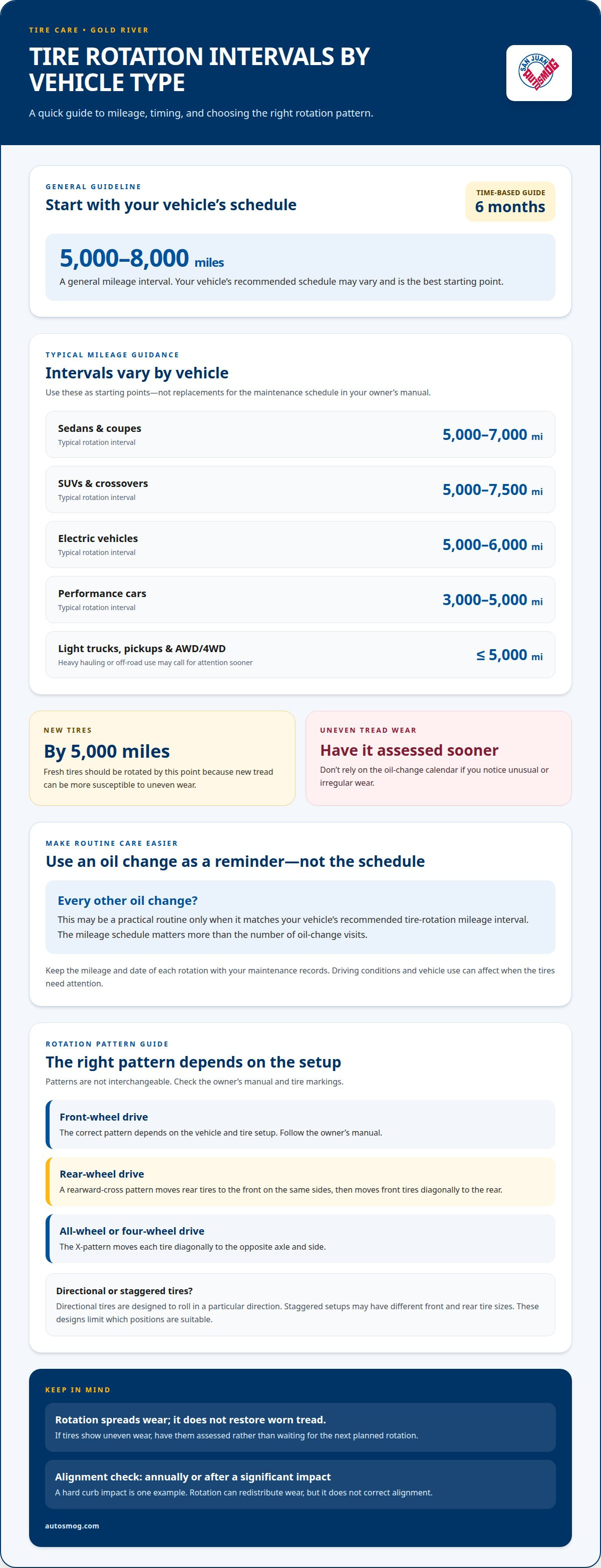
Most tire manufacturers recommend rotating tires every 5,000 to 8,000 miles. A general time-based interval is every 6 months, but the correct schedule depends on the vehicle, tires, and driving conditions around Gold River. For drivers wondering how often they should get their tires rotated in Gold River, the vehicle manufacturer’s schedule is the best starting point. If you notice uneven wear, have the tires assessed sooner.
Typical mileage guidance varies by vehicle type:
- Sedans and coupes: every 5,000 to 7,000 miles.
- SUVs and crossovers: every 5,000 to 7,500 miles.
- Electric vehicles: every 5,000 to 6,000 miles.
- Performance cars: every 3,000 to 5,000 miles.
- Light trucks, pickups, and AWD or 4WD vehicles: every 5,000 miles or less, especially with heavy hauling or off-road use.
These ranges are useful starting points, not replacements for your vehicle’s maintenance schedule. For example, an SUV used for frequent hauling may need attention sooner than one driven lightly on local roads. Fresh tires should be rotated by 5,000 miles because new tread can be more susceptible to uneven wear. Keep the mileage and date of each rotation with your maintenance records, then plan the next service around your vehicle’s recommended interval and your driving.
Are complimentary tire rotations included with tire purchases or maintenance plans near Gold River? There’s no universal rule: it depends on the seller’s offer or plan terms. Review those terms before counting on a rotation included in a purchase or plan.
A rotation moves tires to different positions to help distribute wear, but the pattern must suit the tires and vehicle. Directional tires are designed to roll in a particular direction, while staggered setups may have different tire sizes on the front and rear axles. These designs limit which positions are appropriate. An oil change can serve as a reminder, but rotation timing should follow the vehicle’s mileage schedule, not simply every oil change. To decide how often to get your tires rotated in Gold River, follow the manual’s guidance and pay attention to visible wear.
Should I get my tires rotated during an oil change?
Pairing a tire rotation with an oil change can make routine maintenance easier to remember. Rotating the tires with every other oil change may work if it matches the vehicle’s recommended mileage interval. Treat the oil change as a reminder, not a substitute for the tire schedule.
Rotation patterns depend on the drivetrain, tire direction, and whether the front and rear tires are the same size. Directional tires are designed to roll in a particular direction, which limits their suitable positions. With differently sized performance tires, each tire may switch sides with its same-sized partner while remaining on the same axle.
For uniform-size, non-directional tires, common patterns include:
- Front-wheel drive: The correct pattern depends on the vehicle and tire setup. Use the owner’s manual’s rotation guidance.
- Rear-wheel drive: A rearward-cross pattern moves rear tires to the front on the same sides, then moves front tires diagonally to the rear.
- All-wheel or four-wheel drive: The X-pattern moves each tire diagonally to the opposite axle and side.
Rotation patterns aren’t interchangeable. A directional design or staggered setup may rule out a pattern intended for uniform, non-directional tires. Use the owner’s manual and tire markings to determine the appropriate arrangement. A suitable pattern moves tires only to positions that match their design, size, and drivetrain.
Visible irregular or uneven tread wear is a reason to have the tires assessed before the next planned rotation. Changes in wear across the set can affect traction, so don’t rely on the oil-change calendar alone if the tread looks unusual.
If an oil change is due, it can be a convenient time to discuss whether a rotation fits the vehicle’s schedule. San Juan Auto Smog offers full-synthetic oil changes, with a multi-point inspection, fluid check, and tire rotation available as options. Explore the Full-Synthetic Oil Change service as part of your routine maintenance planning. Appointments are requested for oil changes, so book ahead.
Why tire rotation helps distribute tread wear
Each tire wears differently because its position affects how it contacts the road. Moving tires helps spread wear across the set, and can include the spare when the vehicle’s setup allows.
Rotation and Even Tread Wear
Tire rotation means moving tires to different vehicle positions to help balance tread wear. Front tires may wear differently from rear tires because steering and driving forces vary by axle. Regular rotations help distribute those differences instead of letting one pair wear faster. On all-wheel-drive vehicles, more even tire wear also helps reduce stress on drivetrain components. Staggered setups, with different tire sizes front and rear, limit which positions the tires can move to.
Effects of Skipping Regular Rotations
Skipping rotations can let one axle’s tires wear faster, leaving the set uneven. That difference can reduce traction and affect handling, especially on wet roads. If you notice uneven tread, have the tires assessed rather than waiting for the next planned rotation. The wear pattern may also indicate an issue that rotation alone won’t address.
Pairing tire service with an oil change can make routine maintenance easier to organize. Use the vehicle’s mileage schedule as your guide and include a rotation when it’s due. An oil change is a convenient reminder, not a reason to rotate tires before the recommended interval.
A rotation also gives you a chance to notice wear that may call for an alignment check. Have alignment checked annually or after a significant impact, such as hitting a curb hard. Before any repair work begins, the Bureau of Automotive Repair’s auto-repair guide explains your right to a written estimate. Alignment affects how tires meet the road; if the angles are off, tread may wear unevenly even after the tires change positions. Rotation can redistribute wear, but it doesn’t correct alignment.
Regular rotations help distribute wear, but they can’t restore tread that has already worn away. Check your vehicle’s schedule and respond to visible wear patterns so you can address tire condition before it affects traction and handling.
Vehicle owner’s manual and manufacturer schedules
Your owner’s manual is the best starting point for the rotation interval because the vehicle manufacturer sets maintenance guidance for that model. Look in the maintenance schedule or index for tire rotation instructions. The schedule may specify mileage, time, or both. Follow the listed interval rather than relying only on a general rule or the timing of an oil change.
Driving conditions can affect how quickly tread wears. Frequent short trips, heavy loads, or rough roads, for example, may create different wear patterns than steady driving on smooth roads. If you notice uneven wear before the scheduled rotation, have the tires assessed sooner. Rotation can help distribute wear, but it won’t fix a separate issue affecting steering or tire contact with the road.
Keep a simple record of each rotation’s date and mileage. This makes it easier to plan the next service and may matter for tire manufacturers’ tread-life warranties, which can require proof of regular rotations. Save service receipts with your vehicle maintenance records. If you bought the vehicle used and don’t have a complete history, start tracking rotations at the next service rather than guessing when the previous one took place.
Evenly worn tires support consistent traction across the vehicle, while a missed rotation can allow position-related wear to build. Let your manual’s schedule guide the timing. If the tires show an unusual pattern, arrange an assessment rather than assuming rotation will solve the cause. An inspection can help distinguish ordinary wear from a concern involving alignment or steering components.
For Gold River drivers, the practical next step is to compare your mileage and tire condition with the manual’s schedule. A multi-point inspection can include a tire condition review when wear looks uneven or you’re establishing a maintenance baseline. At San Juan Auto Smog, multi-point inspection, fluid check, and tire rotation are available as options with a full-synthetic oil change—not automatic inclusions.
San Juan Auto Smog: Tire Rotation
San Juan Auto Smog at 4701 San Juan Ave, Fair Oaks, CA 95628 provides tire rotations for Gold River drivers whose vehicles are due for service or showing uneven tread wear. As a STAR-certified Test & Repair station (license RC303707), the shop can also diagnose and repair a vehicle that fails its smog check. The rotation pattern is selected to suit the vehicle and tire setup, moving tires between appropriate positions.
If your oil change is also due, you can pair tire maintenance with a Full-Synthetic Oil Change. San Juan Auto Smog offers full-synthetic oil changes, with a multi-point inspection, fluid check, and tire rotation available as options. Keeping both on your routine service calendar makes it easier to stay current without relying on memory alone. Follow the manufacturer’s schedule for rotation timing, and arrange an assessment sooner if you notice unusual wear. Smog checks on 2000 and newer vehicles don’t need an appointment, but please book ahead for oil changes and for smog checks on 1999 and older vehicles, RVs, vans, and heavy trucks.
For help planning tire maintenance or an oil change, contact San Juan Auto Smog. Text (916) 961-6009 to make an appointment.
Make your next maintenance visit count
Choose a routine that makes vehicle care easier to keep up with. Keep tire service and other maintenance notes together so your next visit can focus on what’s due. If you’re deciding how often to get your tires rotated in Gold River, use your vehicle’s schedule as a guide and watch for changes in tread condition.
San Juan Auto Smog offers tire rotations and Full-Synthetic Oil Changes, along with STAR-certified smog checks for Gold River drivers and Older Vehicle Smog Checks for vehicles from 1999 and earlier. As a STAR-certified Test & Repair station (license RC303707), the shop handles Test & Repair work under license RC303707. Pairing maintenance during a visit can help you organize routine care, while keeping each service focused on its proper purpose. Smog checks on 2000 and newer vehicles don’t need an appointment, but please book ahead for oil changes and for smog checks on 1999 and older vehicles, RVs, vans, and heavy trucks.
For help planning your next tire rotation or another maintenance visit, contact San Juan Auto Smog today at 4701 San Juan Ave in Fair Oaks. A clear maintenance plan can make caring for your vehicle feel more manageable. Text (916) 961-6009 to make an appointment.
Frequently Asked Questions
How often should tires be rotated by mileage or time?
A common guideline is every 5,000 to 8,000 miles or every 6 months. Use whichever comes first as a planning reminder, then follow your vehicle’s specific schedule. For example, if you drive relatively few miles, the time interval still helps you remember to review tire condition. Keep the rotation date and odometer reading with your maintenance records to track the next service.
What tire rotation schedule does the vehicle owner’s manual recommend?
Your owner’s manual gives the schedule for your particular vehicle. Look for tire rotation instructions in the maintenance section; the recommendation may specify mileage, elapsed time, or both. If the manual is unavailable, a technician can help identify the appropriate schedule. Keeping the guidance with your service records makes it easier to plan rotations consistently.
How often should tires be rotated for front-wheel drive, rear-wheel drive, and AWD vehicles?
Use the vehicle’s owner’s manual for the interval, since drivetrain alone doesn’t establish one schedule for every model. Light trucks, pickups, and AWD or 4WD vehicles may need rotation every 5,000 miles or less, particularly with heavy hauling or off-road driving. For front-wheel and rear-wheel drive cars, follow the manufacturer’s maintenance schedule and choose a pattern suited to the tire setup.
Does tire type or driving style change the recommended tire rotation interval?
More articles
- San Juan Auto Smog vs Bluautorepair: A Fair Comparison
- Brake Check in Orangevale: What’s Included and What It Costs
- How to Find an Honest Smog Shop Near Gold River
- How to Make My Car Last Longer in Citrus Heights
- San Juan Auto Smog vs Joessmogcheck: A Fair Comparison
- Quick and Reliable Oil Change in Sacramento With Oil Type Advice