When to Rotate Camry Tires and Change Filters

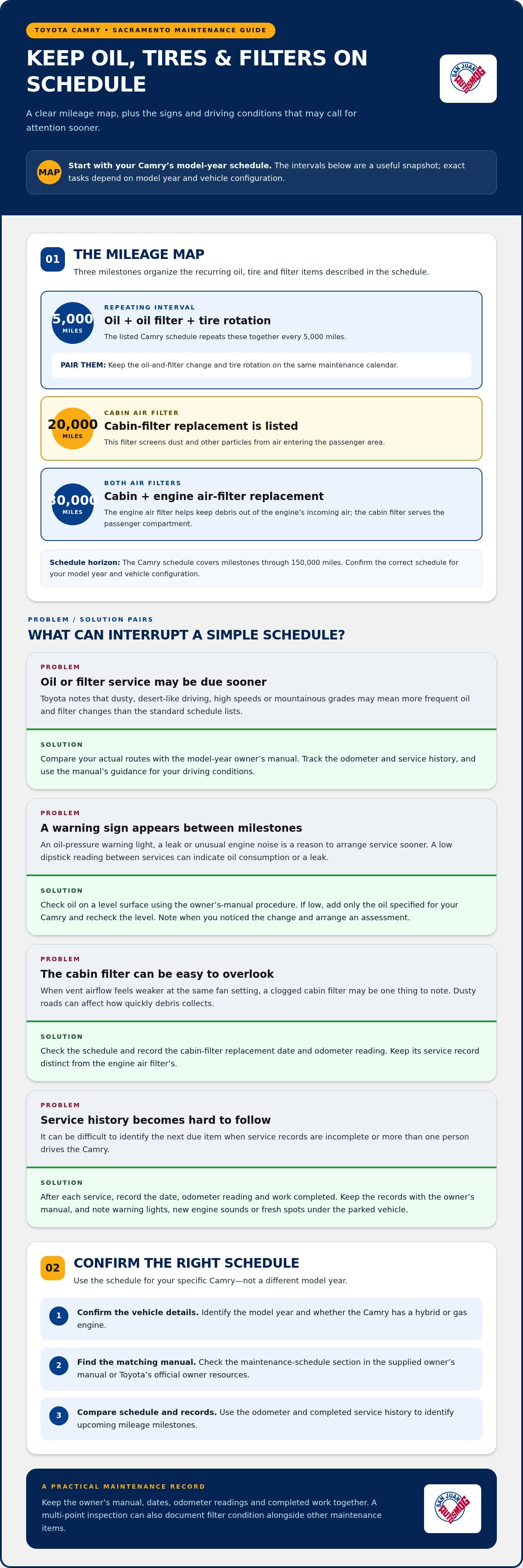
Oil changes and tire rotations belong on the same regular schedule, but the filters deserve attention too. A car maintenance schedule for a Toyota Camry in Sacramento typically pairs oil and oil-filter changes with tire rotations at a regular mileage interval, then adds cabin and engine air-filter service at later milestones. The exact intervals depend on your model year and engine, so always confirm them in the Toyota owner’s manual and warranty guide for your Camry.
It’s easy to focus on oil and tires while overlooking the filters that help keep dust and other particles out of the engine and cabin. This guide explains how to use your Toyota Camry’s maintenance schedule in Sacramento, including when to change oil and filters and how tire rotations fit in. It also covers how dusty roads, high-speed driving, or mountain grades may affect oil and filter service, and what to track as your Camry ages or its mileage increases.
Key Takeaways
- Use your Camry’s maintenance schedule to plan oil changes and tire rotations together, and adjust for demanding driving conditions.
- Learn how the cabin and engine air filters differ, and when each one comes up in the maintenance schedule.
- Understand why maintenance costs can vary with your Camry’s age, mileage, and service needs.
- Find out how to locate the schedule for your specific model year and keep routine maintenance organized.
Table of Contents
Oil and oil-filter changes
Many Camry schedules pair oil-and-filter changes with tire rotations at the same interval; check your model year’s schedule for the exact mileage. A car maintenance schedule for a Toyota Camry in Sacramento should also reflect driving conditions. If the oil-pressure warning light appears, you notice a leak, or the engine develops unusual noise, arrange service sooner.
Engine Oil Changes
Engine oil lubricates moving parts and helps carry heat away from the engine. Follow the interval for your Camry’s model year and record the odometer reading after each service. Toyota notes that owners who drive mainly in dusty, desert-like conditions, at high speeds, or on mountainous grades may need more frequent oil and filter changes than the standard schedule lists.
Check the oil level on a level surface, following the procedure in your owner’s manual. If the dipstick reads low, add only the oil specified for your Camry, then check the level again. A low reading between services can indicate oil consumption or a leak. Note when you notice it and arrange an assessment.
To follow a car maintenance schedule for a Toyota Camry in Sacramento, compare the manual with your actual routes and service history. Frequent driving on dusty roads or mountain routes may affect service needs. Keep the manual and maintenance records together so you can easily identify the next due interval.
Oil Filter Changes
The oil filter captures particles as oil circulates through the engine. Replace it when you change the oil during scheduled service, rather than leaving it for a separate later task. Using the correct filter helps prevent leaks around the filter housing and keeps the service record clear.
After service, record the date, odometer reading, and work completed. This is especially useful if more than one person drives the Camry. Keep your oil change service records with the owner’s manual. Note warning lights, new engine sounds, or fresh spots under the parked car between visits. These details help clarify whether service is due sooner.
Cabin and engine air filters
A cabin air filter screens air entering the passenger area, while an engine air filter helps keep debris out of the engine’s incoming air. Your Camry’s maintenance schedule lists when each filter should be inspected or replaced, and those milestones vary by model year.
Cabin Air Filter
The cabin air filter catches dust and other particles before air reaches the vehicle’s interior vents. Replace it at the milestone your model-year schedule lists, or sooner if it looks clogged. A clogged filter may reduce airflow from the vents, so note changes such as weaker airflow when using the same fan setting.
When the maintenance schedule calls for attention, look for visible dirt, leaves, or damage around the filter. Dusty roads can affect how quickly debris collects. Record the replacement date and odometer reading with your Camry’s service history, then compare them with the model-year schedule.
Engine Air Filter
The engine air filter traps airborne debris before it enters the engine’s air intake. Follow the replacement milestone in your model-year schedule. A clean filter also supports normal engine performance; FuelEconomy.gov has more on how routine maintenance affects your car. An inspection can reveal dirt buildup or damage, but follow the replacement interval for your specific Camry model year.
Keep the two filters distinct: the cabin filter serves the passenger compartment, while the engine air filter protects the engine’s incoming air. Their locations and replacement steps differ, so consult your owner’s manual before attempting a do-it-yourself inspection. If either filter looks damaged or heavily soiled, have it assessed rather than relying on appearance alone.
At routine service, ask for both filters to be inspected and recorded separately. A multi-point vehicle inspection, available as an option with a full-synthetic oil change, can help document their condition alongside other maintenance items. Replacing a filter at its scheduled milestone keeps your maintenance records organized and helps you avoid overlooking the cabin filter while focusing on engine service.
What are Toyota Camry maintenance costs in Sacramento, California?
A maintenance-cost estimate projects scheduled care and repairs over a stated ownership period. These totals describe broad ownership periods, not a set price for a specific service visit in Sacramento.
Projected spending generally rises as a Camry ages and reaches higher-mileage service milestones.
Use that pattern as a planning reference, not as a bill or a prediction of what your Camry will need. Actual maintenance depends on the model year, mileage, condition, driving habits, and completed service history.
For a Sacramento budget, separate routine maintenance from repairs. Start with the model-year schedule, record completed work, and note upcoming mileage milestones. A Camry with overdue maintenance may need a different plan from one with current records. A multi-point inspection can help identify what needs attention now and what can stay on the maintenance calendar.
Use any published ownership-cost estimate as a broad planning benchmark, then organize your own records by date and odometer reading. This makes it easier to distinguish scheduled work from an unexpected repair and to discuss priorities clearly. A written list of completed and upcoming items also helps keep maintenance decisions focused on the Camry’s actual age, mileage, and condition.
How can I check the official maintenance schedule for my Toyota Camry's model year?
An official maintenance schedule is Toyota’s model-specific list of service tasks and intervals. Start with the owner’s manual supplied with your Camry, then find its maintenance schedule section. The Camry schedule covers milestones through 150,000 miles, but the exact tasks depend on model year and vehicle configuration.
First, confirm your Camry’s model year and whether it has a hybrid or gas engine. Use the matching manual, not a schedule for a different year. If you no longer have the printed manual, use Toyota’s official owner’s manuals page to find the correct one. It’s also worth entering your VIN in NHTSA’s recall lookup to check for open safety recalls. Keep the vehicle identification information handy when searching.
Next, compare the schedule with the odometer and your service records. Find the current mileage milestone and its listed maintenance items, then mark the next interval on a calendar or maintenance log. After each visit, record the date, odometer reading, and work completed. This helps prevent missed tasks and duplicate service.
- Match the schedule to the Camry’s model year and configuration.
- Compare the current odometer reading with the schedule’s milestones.
- Review prior records to see which tasks were completed.
- Write down the next due items and keep the record with the manual.
Check the manual’s driving-condition notes, too. Toyota’s schedule says owners who mainly drive in dusty, desert-like conditions, at high speeds, or on mountainous grades may need more frequent oil and filter changes. Compare those examples with your usual Sacramento-area routes instead of relying on the odometer alone.
If records are incomplete, organize the known service history before planning future work. A multi-point inspection can help document your Camry’s current condition and identify maintenance items to track alongside the manual.
San Juan Auto Smog: Full-Synthetic Oil Change
San Juan Auto Smog offers full-synthetic oil changes, with a multi-point inspection, fluid check, and tire rotation available as options. Camry owners can book oil service when their maintenance schedule calls for it. Follow the oil type and interval specified for your model year, and keep the service date and odometer reading with your records. A clear record makes it easier to plan your next visit.
Camry owners in Fair Oaks, Carmichael, Sacramento, Citrus Heights, Orangevale, and Gold River can plan an oil change around their vehicle’s maintenance needs. If a smog check is also due, you can arrange it alongside oil maintenance; San Juan Auto Smog is a STAR-certified Test & Repair station (license RC303707), and the Bureau of Automotive Repair Smog Check page explains the program. A full-synthetic oil change covers scheduled oil service, but it does not replace other maintenance or determine a smog result.
Smog checks on 2000 and newer vehicles don’t need an appointment, but please book ahead for oil changes and for smog checks on 1999 and older vehicles, RVs, vans, and heavy trucks. Sacramento drivers can find local details on our Sacramento smog check page. Contact San Juan Auto Smog to schedule the maintenance your Camry needs.
Make Your Next Maintenance Visit Count
Use your maintenance log to make the next visit a fresh starting point. Bring the Camry’s service records and note any changes you’ve noticed, such as weaker cabin airflow or a new oil warning. These details help keep the conversation focused on your car’s needs and appropriate next steps.
A car maintenance schedule for your Toyota Camry in Sacramento works best as a living record, updated after each service and adjusted to your driving conditions. San Juan Auto Smog is a STAR-certified Test & Repair station (license RC303707) offering full-synthetic oil changes and STAR-certified smog checks. It also performs Older Vehicle Smog Checks for vehicles from 1999 and older. A smog check and oil change can be planned together for convenience, but an oil change alone does not determine a smog result.
Contact San Juan Auto Smog to plan your next service. A clear record and a practical maintenance plan can help you care for your Camry with confidence.
Frequently Asked Questions
What is the recommended Toyota Camry maintenance schedule by mileage and time?
Use the owner’s manual for your Camry’s exact model year and configuration. Check both mileage and time instructions, then compare them with dated service records. Choosing an independent shop for routine maintenance does not by itself void a new-car warranty, but keep receipts showing the work and parts used. If you bought the vehicle used, ask for any available maintenance documents and note gaps. This gives you a clearer starting point for planning future care without assuming previous owners completed every listed task.
What maintenance does a Toyota Camry need at 5,000, 10,000, and 15,000 miles?
Use the maintenance table for your specific Camry to identify each milestone’s tasks. The odometer alone doesn’t show whether previous work was completed, so compare the listed items with receipts or service records. For the 15,000-mile milestone, follow the matching model-year schedule rather than carrying forward tasks from another interval. Mark completed items and the next due work in one log.
When should Toyota Camry engine oil and filter be changed?
Follow the interval for your Camry’s model year and the oil specification in its owner’s manual. At the next service, compare the receipt with the manual and confirm that it records both oil and filter work. Keep the receipt with your maintenance log. If you notice a warning light or a new leak between visits, record when it began and arrange an assessment.
When should Toyota Camry transmission fluid, coolant, spark plugs, and brake fluid be serviced?
Check the model-year schedule for each item separately, since fluid and spark-plug service instructions can differ by Camry configuration. Note whether the manual calls for an inspection or replacement, then compare that instruction with your service records. For a used Camry with incomplete records, list each item and its last documented service date, if available, before planning maintenance.
Does Sacramento's hot, dry climate or traffic change Toyota Camry maintenance intervals?
Sacramento’s climate and traffic don’t create one universal interval for every Camry. Use the driving-condition guidance in the manual and compare it with your regular use, including repeated short trips or extended idling. Choose a shop registered with the California Bureau of Automotive Repair, track your odometer and service dates, then follow the matching schedule. This helps distinguish your actual driving pattern from assumptions based only on location.
More articles
- Where to Get a Diesel or RV Smog Check Near Sacramento
- Power Steering Fluid Top-Off in Fair Oaks: How to Check and Add Fluid
- How Much Should a Smog Check Cost in California?
- Independent Mechanic Multi-Point Check in Orangevale
- Car Warranty and Oil Changes: What You Pay Out of Pocket
- Seasonal vehicle maintenance in Sacramento to protect your car's value