After-work smog check in Gold River: hours and requirements

For an after-work smog check in Gold River, start with your registration notice: California generally requires a Smog Check every other year for registration renewal, according to the California Department of Motor Vehicles. Eligible gasoline, hybrid, and alternative-fuel vehicles eight model years and newer are exempt from the renewal test, according to the California Department of Motor Vehicles. A smog inspection typically includes a visual check of emissions components, an onboard diagnostic system check, and an emissions measurement.
Knowing what the test covers can make it easier to plan an evening visit and understand what a result means. This guide explains how to check station hours before you go, which California vehicle requirements may apply, and common reasons a vehicle can fail. It also covers how a smog certificate supports registration compliance and why keeping up with routine maintenance matters for your vehicle’s long-term performance and emissions system health. You’ll have a clearer picture of what to expect, whether your car is due for a test or you’re planning ahead.
Key Takeaways
- A smog inspection can include a visual emissions check, an onboard diagnostic system check, and an emissions measurement, depending on the vehicle.
- Plan your visit around the station’s posted hours and book ahead so your vehicle can be inspected before closing.
- A lit check engine light or a loose gas cap can contribute to a failed test, so understanding the result helps clarify what needs attention.
- A California Smog Check certificate is valid for 90 days after issuance, according to the California Bureau of Automotive Repair.
Table of Contents
Smog check purpose and emissions measured
A California smog inspection checks whether a vehicle’s emissions controls are present and operating as expected. A smog inspection may involve checks of emissions-related components and systems. Together, these checks assess different parts of the vehicle’s emissions system.
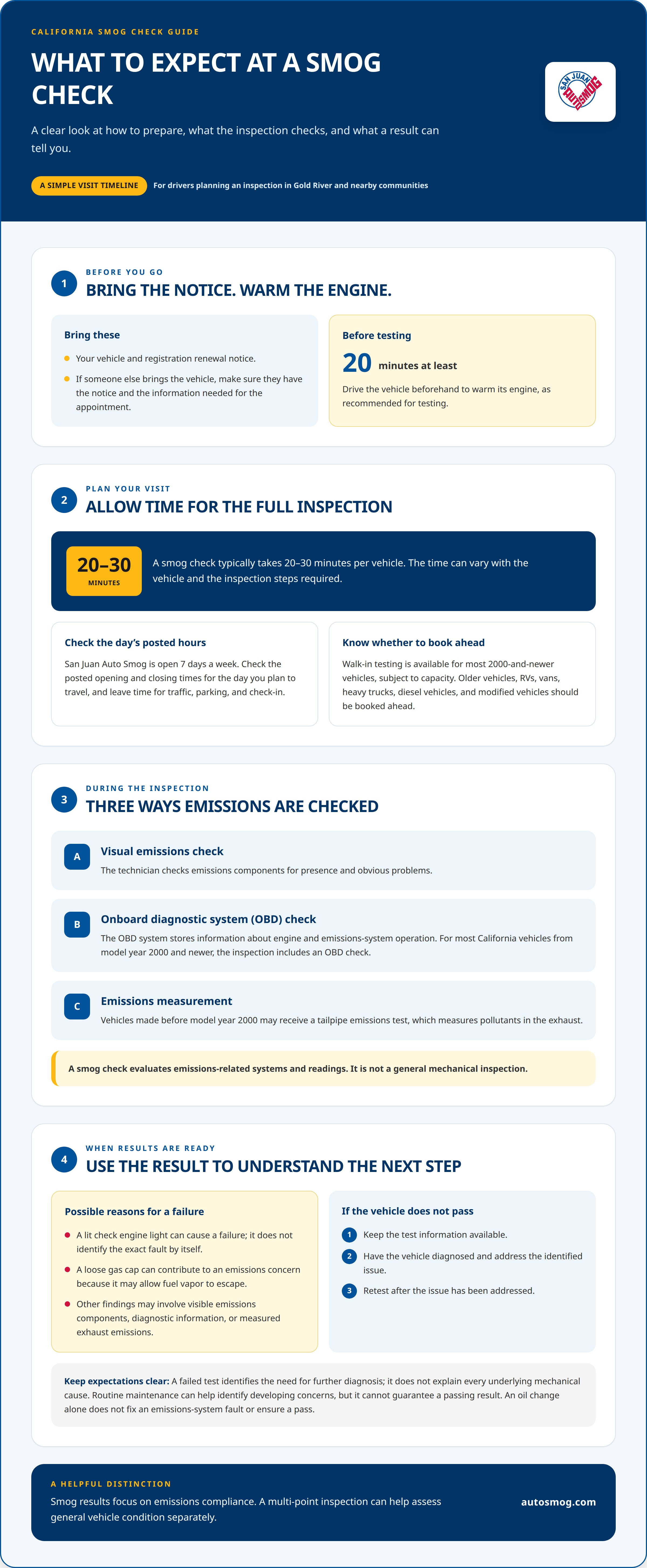
During the visual inspection, the technician checks emissions components for presence and obvious problems. The onboard diagnostic system, or OBD, stores information about engine and emissions-system operation. For most California vehicles from model year 2000 and newer, the inspection includes an OBD check. Vehicles made before model year 2000 may receive a tailpipe emissions test, which measures pollutants in the exhaust.
Bring the vehicle and your registration renewal notice to the appointment. The notice helps identify the reason for the required test, while the vehicle must be available for inspection. If someone else brings the vehicle, make sure they have the notice and can provide the information needed for the appointment.
Inspection time varies with the vehicle and the inspection steps required. For an after-work smog check in Gold River, allow enough time for the complete inspection rather than planning around only the test equipment portion.
Before the appointment, drive the vehicle normally so the engine reaches its usual operating temperature. A warm engine can help the inspection proceed under normal operating conditions. Avoid treating the smog check as a general mechanical inspection: its purpose is to evaluate emissions-related systems and readings.
The results can help explain whether a concern involves visible components, diagnostic information, or measured exhaust emissions. A California smog check gives vehicle owners a clearer view of emissions compliance. If the vehicle fails, the result identifies the need for further diagnosis; it does not, by itself, explain every underlying mechanical cause.
Business hours
San Juan Auto Smog is open 7 days a week (Monday–Friday 8:00 am–6:00 pm and Saturday–Sunday 9:00 am–6:00 pm, per its contact page), giving Gold River drivers weekday and weekend options. Specific daily opening and closing times matter for an after-work visit, so use the posted hours for the day you plan to travel. Don’t assume that arriving near closing leaves enough time for the station to accept your vehicle.
Plan around your actual departure from work, not just the distance from Gold River. Traffic, parking, and the time needed to check in can affect your arrival. If your schedule is tight, choose a day when you can reach the station comfortably within its posted hours. That leaves room for questions about your vehicle or paperwork without rushing.
For an evening visit, book ahead so the shop knows your vehicle’s model year and type before you arrive. That matters most for older vehicles, RVs and motorhomes, diesel vehicles, and modified vehicles. Text (916) 961-6009 to make an appointment.
For a weekend visit, apply the same approach: check the posted hours for that specific day and allow time for travel from Gold River. If a vehicle needs follow-up after its inspection, plan separately for that next step rather than assuming it can be completed before closing. A clear schedule helps you avoid building your evening around an unrealistic arrival time.
An inspection visit can also prompt a review of routine maintenance. If you want a broader look at general vehicle condition, a multi-point inspection can help identify items that may need attention. Maintenance supports vehicle reliability, but an oil change alone does not ensure a passing smog result.
Common causes of test failure
A lit check engine light can cause a California smog test failure, which is why check engine light diagnosis often comes before a retest. It signals that the vehicle’s engine or a sensor has reported a problem that may affect emissions readings. For newer vehicles, the onboard diagnostic system provides information used during testing. The warning light alone doesn’t identify the exact fault, so the test result and diagnosis matter.
A loose gas cap is another possible source of an emissions concern. The cap helps contain fuel vapors, and a poor seal can let vapor escape. The vehicle may still seem to drive normally, so rely on inspection results to identify whether further diagnosis is needed.
Other results may involve visible emissions components, diagnostic information, or measured exhaust emissions. A missing or visibly damaged component, for example, is a different concern from an emissions reading outside the required range. Each result points to a different area for investigation, so understand the findings before choosing repairs.
A failed test is a result, not a repair plan. Have the vehicle diagnosed and address the identified issue before retesting. Repeating the inspection without resolving the problem may lead to the same result. Keep the test information available to help guide the next diagnostic steps.
Routine maintenance can help identify developing concerns, but it cannot guarantee a passing smog result. San Juan Auto Smog offers multi-point inspections, booked as their own service, to assess general vehicle condition alongside emissions concerns. San Juan Auto Smog offers full-synthetic oil changes, with a multi-point inspection, fluid check, and tire rotation available as options. An oil change supports engine maintenance, but it will not by itself fix a warning light, vapor leak, or other emissions-system fault.
Smog certificates and compliance
California’s vehicle rules determine whether a test is due, and a certificate records a completed passing inspection. Knowing your vehicle category and the applicable registration requirements helps you plan what to do next.
Vehicle Applicability and Check Frequency
Vehicle applicability means identifying whether California’s rules require a test for your vehicle. Gasoline, hybrid, and alternative-fuel vehicles from model year 1976 and newer generally need a Smog Check, according to the California Bureau of Automotive Repair. Diesel vehicles from model year 1998 and newer generally need one, according to the California Bureau of Automotive Repair. Diesel vehicles with a gross vehicle weight rating of more than 14,000 pounds do not need a Smog Check, according to the California Bureau of Automotive Repair. For registration renewal, the California Department of Motor Vehicles says a Smog Check is generally required every other year. It also exempts eligible gasoline, hybrid, and alternative-fuel vehicles eight model years and newer from renewal testing. These rules help Gold River drivers distinguish a due test from an exemption.
Finding STAR-Certified Stations
A STAR-certified station is a station designated for California’s STAR program. To find one near Gold River, use the California Bureau of Automotive Repair’s station-finding resources and select the STAR station designation; BAR’s STAR program FAQ explains why some vehicles are directed to STAR stations. San Juan Auto Smog in Fair Oaks is a STAR-certified Test & Repair station (License # RC 303707). Confirm that the listing matches the vehicle type and inspection you need. This step matters because drivers who receive a notice directing them to a STAR station need to choose accordingly. A nearby station’s general smog-testing status alone does not establish that it has the STAR designation.
Outcomes After a Failed Test
A failed test means the vehicle did not meet the inspection requirements, so diagnosis and repairs come before a retest. Keep the result available because it can help identify the emissions concern. As a STAR-certified Test & Repair station (License # RC 303707), San Juan Auto Smog can diagnose the failure, handle emissions-related repairs, and retest the vehicle. Eligible low-income drivers may also want to review BAR’s Consumer Assistance Program for repair assistance. Addressing the identified issue is more useful than repeating a test without a repair plan.
After a passing test, the California Bureau of Automotive Repair says a Smog Check certificate is valid for 90 days. The California Bureau of Automotive Repair also requires stations to charge an $8.25 Smog Check certificate fee. This certificate fee is separate from the station’s inspection charge. Keep the timing in mind if you need the certificate for a vehicle transaction, because its validity period is limited. For registration renewal, the test schedule is generally every other year, according to the California Department of Motor Vehicles.
San Juan Auto Smog
San Juan Auto Smog helps Gold River drivers understand their smog inspection needs and choose an appropriate service. As a STAR-certified Test & Repair station (License # RC 303707) at 4701 San Juan Ave, Fair Oaks, CA 95628, its STAR-Certified Smog Check supports drivers whose notice calls for a STAR station, while Older Vehicle Smog Checks cover vehicles from 1999 and older. RV and motorhome smog checks are also available by appointment.
If routine maintenance is due, combining an inspection visit with a Full-Synthetic Oil Change can save a separate trip and help you stay current with vehicle care. An oil change supports engine performance and reliability, but it does not by itself make a vehicle pass a smog test. San Juan Auto Smog offers full-synthetic oil changes, with a multi-point inspection, fluid check, and tire rotation available as options.
For help with your vehicle’s smog check, contact San Juan Auto Smog. Text (916) 961-6009 to make an appointment.
Make your next maintenance visit count
Planning an after-work smog check in Gold River is also a good opportunity to consider routine maintenance. San Juan Auto Smog offers full-synthetic oil changes, with a multi-point inspection, fluid check, and tire rotation available as options, at its Fair Oaks location, serving Gold River, Fair Oaks, Carmichael, Sacramento, Citrus Heights, and Orangevale. An oil change supports engine maintenance, but does not replace emissions diagnosis or guarantee a passing result.
Use your DMV renewal notice or current registration to guide your next step, and consider whether your vehicle’s age or type requires booking ahead. If a previous test identified a concern, keep the result available so the technician can understand what prompted your visit. Clear information helps keep the conversation focused and practical.
Choose a visit that fits your schedule and gives you time to discuss any maintenance questions. Schedule your smog check with San Juan Auto Smog, and take the next step toward organized vehicle care. Text (916) 961-6009 to make an appointment.
Frequently Asked Questions
What is a smog check?
A smog check is California’s emissions inspection to determine whether a vehicle meets applicable testing requirements. It is separate from routine maintenance: an oil change or general vehicle inspection does not replace emissions testing. A car can seem to run normally and still have an emissions-system issue identified during the test. The result clarifies whether it passed or needs further attention.
What is a smog certificate?
A smog certificate is the official record of a passing California inspection. It supports the applicable registration or vehicle transaction; it is not a repair estimate, warranty, or promise about future test results. Keep the certificate information with your vehicle records in case questions arise about the inspection or related paperwork.
What will fail a CA smog test?
A check-engine light may indicate an issue that could affect an emissions test. A loose gas cap can also contribute to a failure, and inspection results may identify other emissions concerns. If your vehicle fails, use the result to guide diagnosis rather than authorizing unrelated repairs. A warning light, visible component problem, and emissions reading can each call for different next steps.
Which smog check stations near Gold River, CA are open after work?
San Juan Auto Smog is open 7 days a week and serves Gold River drivers, along with nearby communities such as Fair Oaks, Carmichael, Sacramento, Citrus Heights, and Orangevale. For an after-work smog check in Gold River, plan around the station’s hours for your chosen day: Monday–Friday 8:00 am–6:00 pm and Saturday–Sunday 9:00 am–6:00 pm. Daily closing times determine whether you can arrive after work.
More articles
- San Juan Auto Smog vs Smogcheckdeals: a fair, side-by-side comparison
- Fair Oaks Auto Service Ratings, Reviews and Repair Options
- Cheapest smog check for a 1995 car in Gold River?
- Simple Maintenance Checks to Improve Gas Mileage
- Emergency brake check in Gold River: How it operates
- San Juan Auto Smog vs Autocheckcenter: A Fair Comparison