How to extend vehicle life in Orangevale through routine care

Extending a vehicle’s life starts with following its maintenance schedule and keeping clear service records. For Orangevale drivers, the owner’s manual is the best source for guidance specific to the vehicle. Learning how to extend vehicle life with maintenance in Orangevale also means noticing changes in how the car runs and using its mileage history to plan care.
If a vehicle has changed hands or its records are incomplete, gather any available receipts, note the odometer reading, and compare both with the manual. This gives you a practical starting point instead of relying on a generic checklist.
This guide explains how scheduled care, air-filter checks, fluid monitoring, and mileage milestones fit together. It also covers when an owner check is useful and when a mechanic should inspect the vehicle, so you can build a manageable routine and make informed decisions about ongoing care.
Key Takeaways
- Use your owner’s manual to guide oil changes and scheduled maintenance, since service intervals vary by vehicle.
- Check the engine air filter regularly and consider dusty driving conditions when deciding when it needs attention.
- Keep an eye on coolant, washer fluid, and other fluid levels to spot routine maintenance needs early.
- The U.S. Environmental Protection Agency recommends rotating tires every 5,000 miles because they don’t wear evenly; mileage milestones can also help you plan other services.
Table of Contents
1. Scheduled maintenance and oil changes
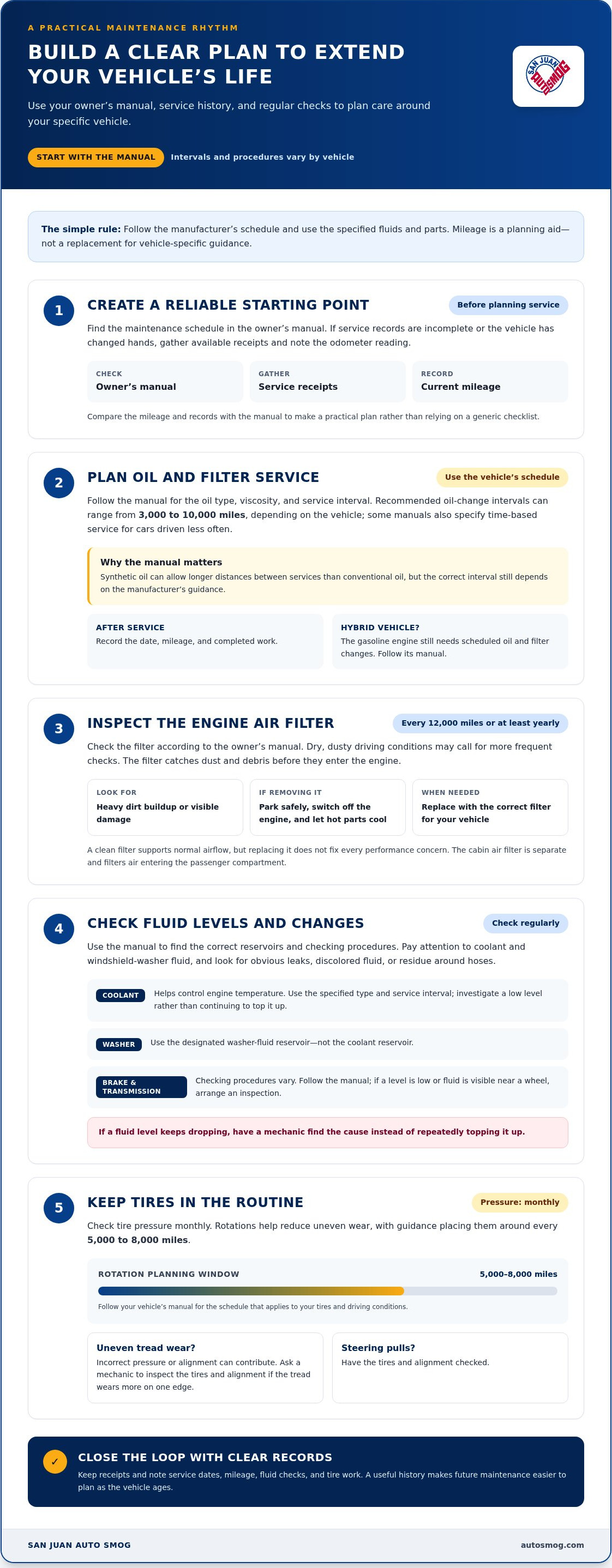
Start with the maintenance schedule in your owner’s manual. The U.S. Environmental Protection Agency advises following the manufacturer’s schedule and using the recommended motor oil. The manual accounts for your engine and driving conditions, so don’t rely on one interval for every car. Consumer Reports says recommended oil-change intervals can range from 3,000 to 10,000 miles, depending on the vehicle. It may also list time-based service for cars driven less often.
Oil changes replace used oil and the filter that catches particles circulating through the engine. Synthetic oil can allow longer distances between services than conventional oil, but the correct interval still depends on the manual. Choose the specified oil type and viscosity, then record the date and mileage. For a higher-mileage vehicle, follow its manufacturer’s guidance rather than choosing oil based on mileage alone.
Hybrid vehicles still need engine oil and filter changes. Their gasoline engines may operate differently from other engines, but they still require scheduled service. Follow the hybrid’s manual for guidance suited to its driving conditions.
Some checks are manageable at home. Park safely, switch off the engine, and follow the manual to check the oil level. Leave oil and filter replacement to a mechanic if you cannot safely reach the filter or handle used oil. For Orangevale drivers learning how to extend vehicle life with maintenance, recording each service creates a useful history and makes future care easier to plan as the vehicle ages.
Routine maintenance needs vary by vehicle, required oil, and services due. When choosing a shop serving Orangevale, look for clear communication about the work and a useful record of completed service, rather than relying on a rating alone. Skipping scheduled maintenance or using oil that does not meet the manual’s requirements can increase wear. The U.S. Department of Energy’s fuel economy maintenance tips explain how routine care like correct tire pressure and the recommended motor oil also help efficiency. Warranty coverage depends on its terms, so keep records and follow the stated maintenance requirements.
2. Air filter replacement in dusty conditions
The engine air filter catches dust and debris before they enter the engine. A clogged filter can restrict airflow, so inspect it according to your owner’s manual. The maintenance guidance recommends checking it every 12,000 miles or at least once a year. Dry, dusty driving conditions may call for more frequent checks.
To inspect a removable filter, park safely, switch off the engine, and let hot parts cool. Use the manual to locate the air-filter housing, then carefully release its clips or fasteners. Note how the filter sits before removing it. If it is heavily coated with dirt, damaged, or difficult to see through, replace it with the correct type for your vehicle. Avoid shaking dust into the housing, and do not reinstall a damaged filter.
A clean filter supports normal airflow, but replacing it isn’t a cure for every performance problem. The maintenance guidance reports that replacing a dirty filter can boost mileage by up to 10%. Treat that figure as a possible benefit, not a guaranteed result for every car. Regular inspection can also help you spot a filter that needs attention before dirt accumulates further.
In Orangevale, dusty routes and driving exposure affect a filter’s condition more than the calendar alone. Hot weather does not automatically mean the engine air filter needs replacing, but checking it during routine service can reveal dust buildup. The cabin air filter is separate: it filters air entering the passenger compartment, not the engine.
California Smog Check requirements apply to vehicles covered by the state’s emissions program, and an air-filter change alone doesn’t determine inspection compliance. For a dustier commute or visible buildup, an automotive technician can inspect the filter and replace it when needed. A multi-point inspection can include checking the filter’s condition alongside other routine maintenance items.
3. Checking vehicle fluids
Check fluid levels regularly, following the locations and procedures in your owner’s manual. In Orangevale’s hot, dry climate, pay particular attention to coolant and windshield-washer fluid. Use the reservoir markings to assess levels, and look for obvious leaks, discolored fluid, or residue around hoses. If a level keeps dropping, have a mechanic find the cause instead of repeatedly topping it up.
Coolant helps control engine temperature, while washer fluid helps clear the windshield. Follow the manual for the correct coolant type and service intervals, since specifications vary by vehicle. Do not treat a low coolant level as a reason to keep driving without investigating. Refill the designated washer-fluid reservoir with suitable fluid, not coolant, and follow the manual if you are unsure what your vehicle requires.
Transmission and brake fluids also need attention, but checking procedures vary. Some vehicles require specific temperatures or operating conditions to check transmission fluid, and some have no owner-accessible dipstick. Consult the manual instead of opening a cap at random. For brakes, note a low reservoir level or visible fluid around a wheel, then arrange an inspection. A mechanic can check for leaks and determine whether service is needed.
Tire care supports the same routine car care plan. Tire pressure should be checked monthly, and rotations help reduce uneven wear; guidance places rotations around every 5,000 to 8,000 miles. Proper alignment helps tires meet the road evenly, while incorrect pressure can contribute to uneven tread wear. If the steering pulls or the tread wears more on one edge, ask a mechanic to inspect alignment and tires.
Keep a simple record of fluid checks and tire services with your maintenance receipts. If coolant, transmission fluid, or brake fluid looks unusual, note the level and date for the mechanic. Regular checks can reveal changes before they become harder to diagnose, while the manual keeps each step specific to your car.
4. Service milestones by vehicle mileage
Mileage helps organize service, but your owner’s manual gives the proper schedule for your vehicle. A maintenance timeline identifies 0 to 36,000 miles as the new-car warranty maintenance period, 36,000 to 60,000 miles as midlife, and 60,000 to 100,000 miles as out-of-warranty service. These are planning stages, not substitutes for the manual.
At 100,000 to 150,000 miles, the timeline highlights high-mileage repairs; 150,000 to 200,000 miles is the final stretch for vehicle care. Treat each milestone as a prompt for a thorough review of service records, coolant condition, belts, hoses, brakes, and battery. Age, driving, and temperature affect wear, so mileage alone doesn’t determine a part’s lifespan.
The U.S. Environmental Protection Agency recommends rotating tires every 5,000 miles because they don’t wear evenly. Use your manual’s schedule if it differs, and ask for a tire inspection when rotation is due. Even tread wear helps you spot pressure or alignment concerns before they become more difficult to manage.
Filter replacement depends on the filter and vehicle: check the engine air filter every 12,000 miles or at least once a year. Spark plugs usually need replacement every 100,000 miles, while transmission-fluid service depends on the manufacturer’s schedule and driving conditions. Check your manual for the correct interval and fluid specification rather than applying one mileage rule to every car.
Notice changes between milestones. Brake squealing, grinding, or a change in pedal feel calls for attention; cracked belts, bulging hoses, or visible fluid leaks also deserve inspection. Battery corrosion or slow starting can signal a need for testing. Battery terminals can be checked for corrosion every three months. If you notice brake changes, arrange a brake check and review other upcoming maintenance at the same time. Before any repair work begins, BAR’s maintenance and repairs page explains your right to a written estimate.
Other components can benefit from mileage-based checks: car brakes commonly need service every 25,000 to 70,000 miles, while shocks and struts can last 80,000 miles or more; rough roads and aggressive driving can shorten their service life. Tire rotation guidance ranges from every 6,000 to 8,000 miles to every 5,000 to 7,000 miles. Tires can last from 30,000 to 80,000 miles, depending on the vehicle, tire model, and driving.
San Juan Auto Smog: Full-Synthetic Oil Change
San Juan Auto Smog offers a Full-Synthetic Oil Change to help you keep up with routine engine care. Follow your owner’s manual for the correct oil and service interval, even if your vehicle has higher mileage. A full-synthetic oil change supports engine performance and reliability, but an oil change alone does not ensure a vehicle will pass a California smog inspection. San Juan Auto Smog offers full-synthetic oil changes, with a multi-point inspection, fluid check, and tire rotation available as options. Appointments are requested for full-synthetic oil changes, so book ahead.
If a smog check is also due, keeping maintenance and emissions testing on your schedule can make vehicle care easier to organize. San Juan Auto Smog is a STAR-certified Test & Repair station (license RC303707) and provides STAR-certified smog checks, including older-vehicle smog checks for 1999 and older vehicles. Smog checks on 2000 and newer vehicles don’t need an appointment, but please book ahead for 1999 and older vehicles, RVs, vans, and heavy trucks. When your DMV renewal notice arrives, the DMV smog inspection page explains what your vehicle needs, and you can see smog checks for Orangevale drivers.
Contact San Juan Auto Smog to discuss an oil change or smog check for your vehicle.
Make your next maintenance step count
Long-term car care is easier when maintenance becomes a simple plan instead of a last-minute reaction. Keep service records together, note new noises or changes in how the vehicle drives, and use those details to guide your next conversation with a technician. Learning how to extend vehicle life with maintenance in Orangevale also means choosing care that matches your vehicle’s needs, rather than replacing parts without a clear reason.
San Juan Auto Smog, a STAR-certified Test & Repair station (license RC303707), offers full-synthetic oil changes, STAR-certified smog checks, and older-vehicle smog checks for 1999 and older vehicles. A smog check evaluates emissions compliance; an oil change supports engine maintenance, and one service does not guarantee the result of the other.
For a straightforward next step, contact San Juan Auto Smog to discuss maintenance or schedule a service. A little organization today can make it easier to care for your vehicle mile after mile.
Frequently Asked Questions
What routine maintenance schedule helps extend a vehicle's life?
Follow the schedule in your owner’s manual and track both mileage-based and time-based services. If you have a used vehicle in Orangevale with incomplete records, gather available receipts and note the odometer reading before planning upcoming care. This gives you a practical starting point and helps distinguish overdue maintenance from work already completed. Update the record after each visit.
How often should you change engine oil based on vehicle and driving conditions?
Follow the oil-change interval in your owner’s manual, since the correct timing depends on the vehicle and its driving conditions. Consumer Reports notes that recommended intervals can range from 3,000 to 10,000 miles, depending on the model. If your manual provides different schedules for driving conditions, choose the one that best matches your regular trips around Orangevale.